Review: 12:01 (1993 movie)

This was a Netflix find that proved to be not awful. Jonathan Silverman (mainly known for comedies such as Weekend at Bernie’s) works in the personnel department of an energy company headed by Martin Landau. He has a crush on one of the firm’s scientists, played by the lovely Helen Slater (Supergirl). One day he finally works up the nerve to talk to her, but a few hours later as everyone is leaving for the day she’s killed in a drive-by shooting.

The next morning at the office he’s shocked to see her alive and well, just like the day before. In fact, everything is just like the day before. He eventually realizes he’s stuck in a time loop, reliving the same day over and over again, with everything resetting at a minute past midnight and no one besides him aware it’s happening.

The made-for-TV movies was based — very, very loosely — on the Richard Lupoff story “12:01 PM” (originally published in The Magazine of Fantasy and Science Fiction‘s December 1973 issue), in which the protagonist finds himself reliving the same 59 minutes over and over again. The story had been adapted much more faithfully in 1990 as a 25-minute episode of an anthology series on the Showtime network with Kurtwood Smith (the father on That 70s Show) as the star, and it was nominated for an Academy Award.

(Lupoff reportedly thought the makers of Groundhog Day had stolen his idea and for a while pursued a lawsuit along with Jonathan Heap, director of the 1990 adaptation, but they finally dropped it when prospects for success seemed slim.)

This adaptation, first broadcast the same year as the release of Groundhog Day, has almost nothing in common with the original story other than the title and the idea of a time loop. The story was a tragedy and the movie is sf romantic suspense with some comedy elements. It’s not great, and Helen Slater’s character seems poorly written, but it has its moments and reportedly has something of a cult following.

Incidentally, Lupoff ended up writing two sequels, naturally titled “12:02 PM” (F&SF Jan/Feb 2011) and “12:03” (F&SF Sep/Oct 2012), but unfortunately I’ve never read any of the original short stories.


Link: http://youtu.be/nbxN4o7tmB8


Facebooktwitterredditpinterestlinkedintumblrmailby feather

People describe their experiences with bionic eyes

At the Mayo Clinic, a blind man with retinitis pigmentosa describes his first impressions of his new bionic eye. The vision is primitive, but he is able to see something, and his description of the experience is worth listening to.


Link: http://youtu.be/Mu5099aJWcU

Here’s a news report explaining it in more detail:


Link: http://youtu.be/GNB4HatZfco

And here’s a similar experience at the Duke Eye Center here in North Carolina:


Link: http://youtu.be/CiyGOUHD2nI

This treatment does not restore anything really approaching normal vision, but it’s tiny step in that direction. Eventually the technology will improve and be applicable to a wider range of conditions.


Facebooktwitterredditpinterestlinkedintumblrmailby feather

Review: Edge of Tomorrow (2014 movie)

In the not-too-distant future Earth has been invaded by aliens called “mimics,” which is odd, because they don’t actually seem to mimic anything. In fact, they’re pretty original as aliens go, most of them looking like about a hundred flailing, whip-like tentacles knotted together.

The invaders have taken over pretty much all of Europe, though humans still control the other continents and Great Britain for now and are fighting back.

The protagonist — he’s no hero, at least at the outset — is an American PR officer with no combat training who is suddenly forced to take part in a D-Day-like invasion, during which he gets caught in a time loop, reliving the day over and over again, something we’ve all seen before, but this time with a science fictional explanation of sorts.

I hadn’t read much about the film before seeing it, so I didn’t recognize the lead actor. He looked familiar, and I kept thinking he looked like an aging version of Tom Cruise, but it wasn’t until I saw the end credits that I discovered there’s a reason for that. The heroine is played by always appealing Emily Blunt.

It’s not a great film, and much of it consists of war-movie clichés combined with computer-generated action scenes, but it does have the virtue of being actual sf, like something we might have read in the 1950s or 60s, so it’s a fair amount more interesting than the average special effects shoot-’em-up. And if you can’t stand the star, the film has the added virtue of letting you watch him get killed over and over again in different interesting ways.


Link: http://youtu.be/vw61gCe2oqI


Facebooktwitterredditpinterestlinkedintumblrmailby feather

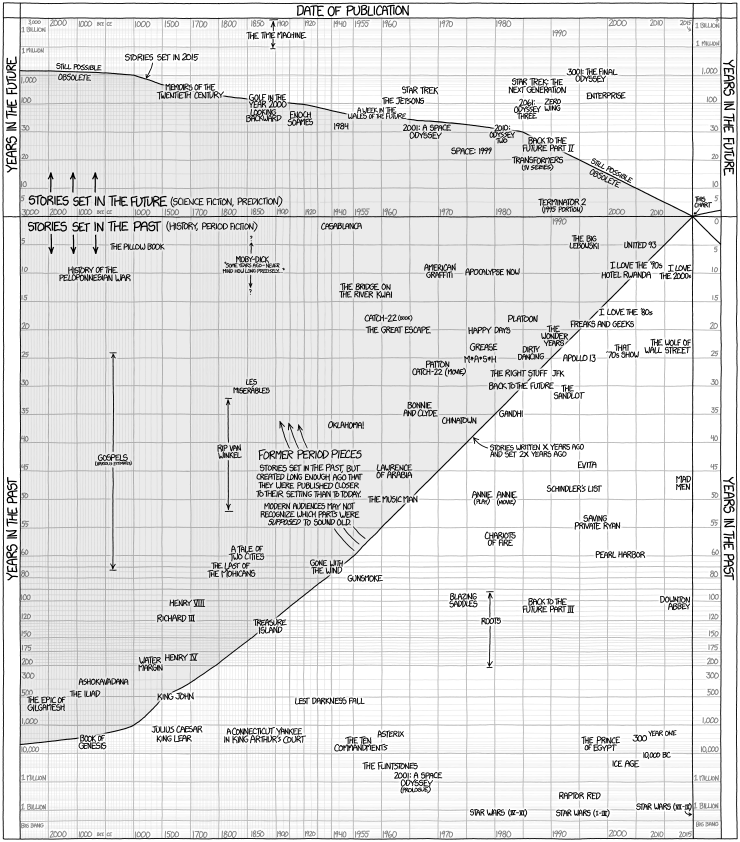
XKCD graph of stories set in the past and future (at the time they were published)

It takes a minute to figure out what you’re looking at on this graph, but once you get the point it’s quite interesting. A title’s horizontal position represents how long ago the story (novel, movie, or whatever) first appeared, with today at the right and the remote past at the left. The vertical position shows how many years into the past or future the story was set relative to when it was created.

For example, the classic film Casablanca (1942) was set only a year or so before the film’s release, so it appears about the middle of the graph horizontally and just below the line dividing settings in the past from those in the future. The more recent movie The Wolf of Wall Street (2013) is mainly set 20 or 25 years before the film’s release, so its title is almost all the way to the right and vertically between the lines for 20 and 25 years in the past.

Both axes are roughly logarithmic. That is, close to the present, each unit of distance means just a few years, but farther away from it, the same amount of distance can stand for a century, a millennium, or many millions of years, depending on how far from the axis you go. (A look at the numbers should make this clearer.)

Above the horizontal “present-day” axis is a shaded area representing times that are in the past for us today but in the future at the time the work was written.

The shaded area below the axis covers stories set in the past at the time they were published, but “created long enough ago that they were published closer to their setting than to today.”

Here’s the graph. You can click on it to see a larger version.

Graph of stories of the past and future

You can also see it at the XKCD website here: http://xkcd.com/1491/

Direct link to large version: http://xkcd.com/1491/large/

For a more detailed explanation, see the Explain XKCD website page here: http://www.explainxkcd.com/1491/. Note that in general you can usually get an explanation of an XKCD comic by typing “explain” immediately before “xkcd” in the web address (URL) and hitting return.

For my other posts referencing the XKCD web comic see this link.

In particular, here are other XKCD graphs I’ve mentioned in earlier posts:

  • Rapidity of legalization of mixed-race versus same-sex marriage (link)
  • Ocean depth graph (link)
  • The total mass of humans, pets, and livestock versus all other land mammals (link)
  • Partisan and ideological makeup of Congress (House and Senate separately) (link)

For the latest XKCD comic click here: http://www.xkcd.com


Facebooktwitterredditpinterestlinkedintumblrmailby feather

The final walk of a police dog

A retired police dog named Judge had an impressive career in the West Deptford Township Police Department in New Jersey, among other things assisting in the arrest of 152 suspects.

In 2013, having served six years on the force, the nine-year-old German shepherd had to retire because of problems with his teeth, living at home with Corporal Mike Franks. Other serious illnesses led to large veterinary bills at the University of Pennsylvania Veterinary Hospital, and since the city budgeted only $300 for veterinary care, the police turned to a crowdfunding site to ask for help, hoping to raise $10,000. The GoFundMe campaign began on Wednesday, November 12, and by Friday, November 14, it had collected $12,700 from 121 donors. In addition, a local veterinary clinic offered to provide future treatment for free.

Unfortunately, Judge’s illnesses, most seriously Cushing’s Disease, proved too serious, and by last week he was no longer able to eat, so a decision was made to end his suffering. When Judge took his final walk into the clinic gripping a training sleeve in his mouth, he walked between a double line of human and dog officers. The cops were moved to see a similar honor guard inside.

There are photos and more details at this link.


Facebooktwitterredditpinterestlinkedintumblrmailby feather

Review: The Family Man (2000 movie)

Circa 1987 Nicolas Cage said goodbye to his tearful girlfriend Téa Leoni to fly to London for a job with Barclay’s Bank, reassuring her he’d be back. Thirteen years later he’s a rich Wall Street executive who never saw her again. He lives alone and dates hot women who like his money, and he’s mean enough that on Christmas Eve he orders people to attend a meeting the next day.

But he’s not really a bad guy. When he stops in a store later that night and sees an armed confrontation between the store owner and a man (Don Cheadle) trying to cash a lottery ticket the owner insists is fake, Cage bravely intervenes to defuse the situation and even tries to talk Cheadle into turning his life around, which Cheadle finds amusing, given what he knows is about to happen to Cage. (Exactly who and what Cheadle is we never find out, but he might be trying to earn his wings.)

Christmas morning Cage is shocked to wake up not in his luxury Manhattan apartment but a house in New Jersey that he apparently shares with Téa Leoni, their two kids, and a dog. In a baffled panic he commandeers the family minivan and drives it to Manhattan, only to discover that his old life has vanished. The only person who recognizes him is Don Cheadle, who declines to explain anything but seems to be having a good time. It probably helps that he’s now driving the Ferrari that used to belong to Cage.

(In fact, the Ferrari in question actually did formerly to belong to Nicolas Cage the actor, not just the character. Cage has driven his own car in more than one film. The weird but snazzy classic car he has in The Sorcerer’s Apprentice (2010) was his as well.)

With nowhere else to go, Cage heads back to New Jersey and tries to fit into his alternate life. Presumably because he’s afraid of being thought crazy he says nothing about what happened. His precocious little daughter realizes something odd is going on and decides he’s an alien temporarily taking her father’s place, but as long as he promises not to do anything horrible to her or her baby brother she’s willing to help him out and even formally welcomes him to Earth.

At this point things become reasonably predictable as he realizes that for all its horrors (he works for his father-in-law as a tire salesman) this life isn’t so bad. Téa Leoni is even more appealing than he remembered, and he quickly learns to care for her and his children. Of course, it’s unlikely much that much of this would surprise anybody.

But it still proves to be a likable romantic comedy fantasy, not flawless but worth seeing if you’re in the mood for that sort of thing. I liked it, anyway.


Link: http://youtu.be/OnouJoQs52c


Facebooktwitterredditpinterestlinkedintumblrmailby feather

Review: X-Men Origins: Wolverine and The Wolverine (2009 and 2013 movies)

Hugh Jackman’s Wolverine (Logan to his friends) may be the most popular character in the X-Men movies, so it’s not surprising that he would get a couple of solo films.

The first, set mainly in the 1970s I think, tells how he came to acquire his powers from a mixture of mutant abilities and advanced technology and how he came to lose his memory. As a lot of reviewers complained, the film is marred by an overload of clichés, even, no kidding, a shot from overhead as a character looks up and cries “NOOOOO!” in reaction to some tragedy, something so often parodied that at this point it’s hard to imagine anyone trying to get away with it.

On the other hand, for all its flaws it’s not unwatchably awful. In fact, as someone who’s rather short for his weight, I quite liked the scene in which Wolverine gets his skinny ass thoroughly kicked by a fat guy.

The first film reveals that Logan has been around for a while and fought in the Civil War as well as World Wars I and II. In the second, set mostly in the present day, he’s invited to go to Japan to say farewell to a Japanese soldier he’d befriended during WW2. The man had later become a major Japanese industrialist and is now coming to the end of his life.

Strangely enough, Logan seems to remember the guy despite his amnesia. Maybe this is explained and I just missed it. Then again, I didn’t notice the inconsistency until I started writing this. That probably classifies it as what Alfred Hitchcock once called an “icebox scene,” i.e., a plot hole that doesn’t occur to you while watching a movie but only later when you’re back home taking something out of the refrigerator and suddenly think, “Hey, wait a minute.” Hitchcock implied he didn’t worry too much about that sort of thing. (The terms seems to have morphed into “refrigerator logic” in current usage.)

Anyway, in Japan Logan encounters various mysteries and menaces and a couple of very attractive women, one the industrialist’s granddaughter and the other her childhood best friend. The latter is a sort of ninja and a mutant besides. For some reason Logan takes up with the granddaughter despite having more in common with her friend, not to mention the fact that unlike the granddaughter the friend doesn’t have a fiancé. I also found the friend more physically attractive, in an exotic way, but maybe that’s just me. If Logan prefers the more conventional beauty, that just leaves more exotic hot mutant female ninjas for the rest of us.

The second film is definitely better than the first, but I wouldn’t recommend either to anyone not already inclined to see them.

Incidentally, one amusing bit of trivia: It seems Hugh Jackman, an Australian, initially didn’t realize that there is an animal called the wolverine and hence thought the term was an adjective meaning something on the order of “wolf-like.” So when he was originally cast to play Wolverine in the first X-Men movie he reportedly spent a lot of time studying wolves to develop mannerisms for his character.


Link: http://youtu.be/LPmbGzQaOCs


Link: http://youtu.be/Rh1LdTFkm7I


Facebooktwitterredditpinterestlinkedintumblrmailby feather

John Oliver on the plight of interpreters who helped the U.S. in the Iraq and Afghan wars

Early I posted a John Oliver clip I said was entertaining but not his best bit. Here’s example of a very good one. It’s reasonably funny but, as often with Oliver’s reports, also informative and substantive and valuable. My respect for John Oliver keeps increasing.

To summarize: The U.S. military in Afghanistan and Iraq has been very dependent on local interpreters, people who speak English and the local language, usually because they live there. They’ve saved a lot of American lives, and laws have been passed authorizing visas for them to come to the U.S. But the bureaucratic requirements are so ridiculous and the processing so glacially slow that it can take years, if ever, for the visas to actually be granted. In fact, visas are no longer being granted at all for Iraqi interpreters, and current plans are to stop giving them to Afghans at the end of 2015.

In the meantime, the interpreters and their families are facing death threats. Be aware that Oliver resorts to words deemed offensive to some, but the subject deserves it. (I’d use my entire vocabulary as a U.S. Navy veteran and start drawing on Marine Corps and Coast Guard terms.)


Link: http://youtu.be/QplQL5eAxlY

As a bonus, here’s one he did on tobacco companies, which continue to make a killing (in every sense) selling tobacco overseas, often to children:


Link: http://youtu.be/6UsHHOCH4q8


Facebooktwitterredditpinterestlinkedintumblrmailby feather

The British Labour Party enters the pink / magenta dispute

In a post here a bit over a year ago (link) I pointed out that a short video on the otherwise excellent Minute Physics YouTube channel managed to confuse pink (basically red plus white light) with magenta (white minus the middle wavelengths). That post still draws hits for some reason and has prompted a few comments, including one suggesting that people besides the folks at Minute Physics do indeed call magenta pink.

Curiously enough, this subject has lately come up in British politics. In the run-up to May’s parliamentary election in the UK, the Labour Party has lately caught flak for using a pink van as part of an outreach to women voters. In response to the mockery, Labour has claimed that the van isn’t really pink but actually cerise or magenta.

As you might expect, HBO’s John Oliver had a reasonably entertaining short report on this in the latest episode:


Link: http://youtu.be/2sWRXr2Yu9g

It’s not his best bit (I’ll get to one of those in a separate post), but since it ties in with the Minute Physics thing I thought it worth a mention.


Facebooktwitterredditpinterestlinkedintumblrmailby feather

Review: Wool by Hugh Howey (2012 novel)

This is old-school science fiction set in a huge underground “silo,” a vertical city where a remnant of humanity takes shelter from a deadly surface environment, their only view of the outside coming from a set of live camera images shown on wall-size viewscreens on the top level.

The silo is run by an elected mayor and an appointed sheriff, but a lot of power resides with the IT department, a largely autonomous and secretive group of technicians.

The ultimate punishment is expulsion from the silo, something called “cleaning” because the condemned, supplied with steel wool and a protective suit able to keep them alive for a short time, is expected to clean the cameras as his or her final act.

Howey self-published the novel as a series of short e-books, the first (a stand-alone novelette) offered for free. Wool proved very popular and there was talk of a print edition and a film adaptation, though I haven’t seen anything on either in a while

I wouldn’t call Wool the best thing since pickles, but it is pretty good. There are two sequels, Shift and Dust, and Howey has written a number of other things. See his website (link) for more.


Facebooktwitterredditpinterestlinkedintumblrmailby feather