I’m not a particular fan of former pro wrestler and former Minnesota governor Jesse Ventura, but in this clip he has some interesting responses to recent comments from Republican presidential candidates.
Ventura’s language may offend some, and his replies aren’t perfect, but in general it’s enough to make you wonder why, if even Jesse Ventura understands at least some of this stuff, these other guys don’t.
Jimmy Stewart is a successful Indianapolis surgeon happily married to Doris Day. They and their young son have been in Paris for a medical conference and are playing tourist in Morocco when a murdered man whispers an urgent message warning of an assassination. Before they can relay the message to the authorities (or figure out just which authorities they can trust), they learn the son has been kidnapped to ensure their silence. Their efforts to find the boy lead them to London.
A more polished remake of Hitchcock’s 1934 original, this is a very entertaining suspense film with Hitchcock’s usual flashes of humor and an excellent scene that takes place during a concert at the Albert Hall in London. Bernard Hermann, who scored the film, appears on screen conducting the London Symphony Orchestra and the Covent Garden Opera Chorus. Interestingly, he chose to retain (with some minor modifications) the “Storm Clouds Cantata” composed by Arthur Benjamin for the corresponding scene in the 1934 film, though Hitchcock had invited Hermann to write a new piece.
There are some seeming plot holes, but it’s possible to infer explanations for them based on clues in the film. (They’re in a sense the opposite of what Hitchcock called “icebox scenes,” those provoking plot questions that occur to viewers only hours after they’ve seen the movie and are standing in front of the refrigerator looking for a midnight snack.)
Hitchcock enjoyed working with Stewart and wanted Doris Day for the female lead based on her performance in the 1951 film Storm Warning. She was at the time still mainly known as a singer, however, and at least one of the producers was strongly opposed to using her in a serious suspense film.
Hitchcock said so little to her during shooting that she finally asked him what she was doing wrong. He responded, in his usual deadpan way, “My dear Miss Day, if you weren’t giving me what I wanted, then I would have to direct you.” In fact, she’s excellent in the film, probably the best actor in it. If you remember her mainly from lightweight romantic comedies it might surprise you how convincing she could be as a dramatic actress.
(Recalling her sweetly innocent romantic roles reminds me of what Oscar Levant once told Jack Paar: “I’ve been in Hollywood so long I knew Doris Day before she was a virgin.”)
Paramount, which produced the film (though it was later re-released by Universal, hence the Universal logo seen in the DVD and Blu-ray versions), insisted that if Doris Day was going to be in the picture, audiences would expect her to sing, so Hitchcock asked the songwriting team of Jay Livingston (composer) and Ray Evans (lyricist) to create a song for her, telling them he had no idea what sort of song he wanted except that it be suited for a mother to sing to her son and might have some sort of foreign element. Two weeks later they came back with “Qué Será Será.” Hitchcock sat expressionless as he listened to it, then declared that while he had told them he didn’t know what sort of song he wanted, he now did know exactly what sort of song he wanted, and that was it.
Incidentally, Livingston and Evans later confessed that the song was one they just happened to have written not long before Hitchcock came to see them. (It had been inspired by a family motto seen in the 1954 film The Barefood Contessa.) They thought it would be better not to mention that, so they waited a couple of weeks to present it.
Unlike Hitchcock, Doris Day reportedly didn’t like “Qué Será Será” at all, dismissing it as a forgettable children’s song, She didn’t even want to record it as a single, though of course in the end she was persuaded to, and it went on to become a hugely popular Oscar-winning hit and later her theme song, one she sang in at least two other movies.
Another interesting bit of trivia: When the murder victim collapses in front of Stewart, Stewart tries to hold him up and as the man slides out of his grip to the ground, the dark makeup on the man’s face comes off on Stewart’s hands, revealing the victim to be wearing a disguise. But the makeup department was unable to find a makeup that could be wiped off so completely and cleanly. Fortunately the actor playing the victim, Daniel Gélin, came up with the solution: Stewart’s hands had light-colored makeup on them that would come off on Gélin’s face, looking just as if it was his makeup being wiped away.
Incidentally, one of Doris Day’s friends in London is played by the lovely Carolyn Jones, later best known as Morticia Addams on The Addams Family television series.
As I keep saying, John Oliver, host of HBO’s Last Week Tonight, is a national treasure. Last Sunday he and the show’s staff did yet another excellent exposé, this one on the stupidity of giving vast amounts of unneeded welfare to rich sports teams. The video runs 19 minutes, longer than I would normally post, but it really is worth your time.
Here are just a few of the notable facts revealed between the jokes:
Ninety percent of U.S. sports stadiums have been rebuilt in the last 20 years with the costs paid by local taxpayers.
In just the years 2000-2010 alone, local governments spent $12 billion on the facilities.
There’s no evidence that the money spent helps the local economy or increases tax revenues.
Six days after Detroit filed for bankruptcy (and among other things slashed pensions owed and promised to elderly retired workers) it got approval to spend $280 million in taxpayer money on the Red Wings, whose owner is worth over $5 billion.
Not only do teams typically pay no rent on the stadiums and get to keep the ticket revenues and broadcast fees, in many cases, additional income — from naming rights, concessions, luxury box rentals, even non-sports-related entertainment events — goes not to repay the taxpayers but to make the teams and their owners even richer.
The owner of the Florida Marlins claimed to be losing money when demanding a new stadium (with fishtanks surrounding the field and even luxury swimming pools overlooking it), but he wouldn’t open the books, and leaked documents later revealed that the team was in fact making lots of money.
John Oliver has no clue what “begs the question” means.
It’s autumn in rural Vermont, the leaves are changing colors, and all’s not quite right with the world.
Edmund Gwenn, best known as Kris Kringle in 1947’s Miracle on 34th Street, plays a retired sea captain who at the start of the film has been shooting at rabbits with about as much success as Elmer Fudd. He’s looking to see what he hit when he comes upon a dead stranger lying in a clearing. Oops. Not wanting to go to jail for an honest accident, he resolves to hide the body. Unfortunately, other people keep happening upon the scene.
Jerry Mathers (later the star of Leave It To Beaver) discovers the body and runs to fetch his mother (Shirley MacLaine in her first film role). Gwenn, hiding behind a fallen tree, is surprised to see that she apparently knew the deceased and isn’t at all distressed by his condition.
MacLaine was 20 at the time, only 14 years older than Jerry Mathers. Such unlikely age differences aren’t uncommon on film. In North by Northwest Cary Grant’s mother was played by an actress (Jessie Royce Landis) only seven years older than Grant. In Chitty Chitty Bang Bang Dick Van Dyke’s father is played by Lionel Jeffries, six months younger than Van Dyke. For that matter, a lot of people probably assume that Roger Moore, who replaced Sean Connery as James Bond, was a younger actor. In fact, Moore is just short of three years older than Connery. Movies are magic.
A local spinster named Miss Graveley (Mildred Natwick) happens upon the scene just as Gwenn is dragging the dead body toward the bushes and casually asks, “What seems to be the trouble, Captain?” (Hitchcock reported called this his single favorite line in any of his films.)
John Forsyth gets involved as well. He’s an unsuccessful abstract painter who is rather attracted to Shirley MacLaine, presumably because he has decent eyesight and she’s Shirley MacLaine. Also, at one point he kisses her and she says, “Lightly, Sam. I have a very short fuse.” Whoa, Nellie.
It’s said that Hitchcock made the film partly as an experiment, to see if American audiences would go for a comedy that was dark and understated and lacked A-list stars. It didn’t work as well as he’d hoped, though it was a big hit in Britain and Italy. I liked it well enough, though I smiled a lot more than I laughed.
Much of the film was shot on location in scenic Vermont, but the fall weather proved so rainy that they ended up building the wooded clearing as a set inside a high school gym.
Carroll, a pediatrician, notes that while a recent survey show some reduction in childhood exposure to violence, crime, and abuse, the numbers remain troubling. He also mentions in passing last month’s Supreme Court decision against a politically-motivated lawsuit that would have invalidated part of the Affordable Care Act based on a bit of ambiguous wording from a drafting error that is plainly contradicted elsewhere in the law, not to mention its legislative history.
The first item he addresses touches on a question that has interested me for some time: Why does healthcare in the U.S. cost so much more than in other developed countries with comparable outcomes? Does it have to do with higher pay for U.S. professional? Carroll points to research (published here) showing what healthcare workers in the U.S. make relative to Americans in other sectors of the economy. Briefly, even after taking into account differenced in education and experience, doctors and nurses make a lot more than their counterparts in other sectors, about 50 percent more for doctors and 40 percent for nurses.
(However, most other people working in healthcare make about the same or a little less than their non-healthcare counterparts after making education/experience/demographics adjustments.)
But the relatively high pay of doctors and nurses doesn’t go very far toward explaining very much about why U.S. healthcare costs so much. As Carroll notes, doctors’ incomes account for under 7 percent of healthcare spending, and pay to nurses comes to less than 7 percent. If all the surplus compensation (above what the counterparts make in other sectors) could be eliminated, it would reduce healthcare spending by just 6 percent.
And, I’d personally add, maybe we want to pay doctors and nurses more, nurses especially.
OK, so if high pay doesn’t explain very much of our high healthcare costs, what does? Carroll doesn’t get into that, but the obvious villain that occurs to a lot of people is health insurance companies. But the health insurance industry’s profit margins are actually pretty modest in comparison with other sectors, and nowadays to a fair extent the amount insurance companies can spend on combined profits and overhead is limited by the Affordable Care Act. What about malpractice lawsuits? Not that big a deal, it turns out. It does add something, but states such as Texas that strictly limit malpractice payouts don’t have significantly lower healthcare costs.
On the other hand, drug companies make loads of money, we tend to have a lot more hardware (MRI and CT machines and the like) than other countries do, and our incredibly complicated and bureaucratic non-standardized system for billing and payments adds a huge level of overhead throughout the system.
Stop me if you’ve heard this, but about a year and a half ago I was seen briefly by a team of three doctors over a period of perhaps an hour, a visit that in the end proved entirely useless. Over the following months I received and paid a whole series of bills for this one visit. These bills were impossible to me to interpret despite my having a degree in math and decades of experience as a businessman and investor. I finally contacted the healthcare system in question and asked for an itemized bill explaining just what the dickens I was being billed for and why the bills kept coming months after the single visit. A short while later I received a non-itemized bill that was identical to the immediately previous bill I’d received except for the words “Itemized Bill” added at the top. (I am not making this up.) The bills did stop at that point, however, no doubt a mere coincidence.
(Updated 2015 July 15 to correct typos and improve clarity.)
In one of Hitchcock’s best films, Jimmy Stewart is a globe-trotting photojournalist temporarily confined to his Greenwich Village apartment by a broken leg. Grace Kelly is his devoted girlfriend, rich, classy, and heavily involved in the fashion industry. She wants him to marry her and settle down, offering to get him a safer and higher-paying job as a fashion photographer. But he loves his work, worries she wouldn’t be happy traveling the world with him, and doubts he’d be comfortable in her circles either, so he’s reluctant. Thelma Ritter, his visiting nurse, thinks he’s nuts.
Stewart deals with his boredom by watching his neighbors who live in the apartments surrounding the courtyard he can see from his window, a group that includes a pair of newlyweds, an eccentric female sculptor, a lonely spinster, a salesman and his disagreeable semi-invalid wife, and an older married couple who sleep on the fire escape in hot weather and lower their dog to the shared courtyard in a basket.
Then one day the salesman’s wife is no longer there and Stewart starts to suspect foul play. At first nobody believes him, including a friend (Wendell Corey) who’s a police detective, but they gradually come to take his concerns seriously.
Hitchcock supposedly cast Raymond Burr (later famous as Perry Mason) as the salesman because with the right glasses and hair he looked remarkably like David O Selznik, the producer of Rebecca (reviewed here) and several other Hitchcock films, who took a hands-on approach to producing that Hitchcock found very annoying.
The set is almost a character in itself. Based in part on photographs taken in Greenwich village, it was built into a huge Paramount soundstage, and Hitchcock even persuaded the studio to tear out the floor so the deep basement (normally used to store furniture) could serve as the ground level of the set, thus adding more total height.
A total of 31 apartments overlooked the courtyard, at least eight of them fully functional with water and electricity. Georgine Darcy, who plays the beautiful young dancer Stewart’s character calls Miss Torso, spent all day in her apartment during shooting, even when she wasn’t needed, entertaining herself by watched the filming and as a result becoming enough of an expert on Rear Window that she later advised film historians about it. Hitchcock insisted that Darcy invent her own dance routines without the help of a choreographer in order to get a more natural performance. Her character is surprisingly well-realized and memorable for someone seen for only a few minutes of the film. (This might also have to do with the fact that she’s hot.)
The distinctive loft apartment with floor-to-ceiling windows on the far right is occupied by a songwriter working on a composition that’s one of the film’s main themes. Almost all the music is sourced on set, from radios, record players, or in the case of the songwriter his piano. The music was recorded by microphones in Stewart’s apartment in order to capture a realistic ambiance. Almost all the shots are seen from his apartment’s viewpoint as well. Hitchcock even directed most of the film from there, communicating with the cast in the other apartments or the courtyard through flesh-colored earpieces they wore.
The songwriter, by the way, is played by Ross Bagdasarian, a real-life professional singer and songwriter better known under the stage name David Seville. While the song in the film was actually composed by Franz Waxman, Bagdasarian wrote a number of hits of the 1950s and 60s including “Come on-a My House,” and “Witch Doctor.” He also invented Alvin and the Chipmunks, writing their songs and singing all the voices.
The script for Rear Window was by John Michael Hayes, who wrote it based on a mystery short story by Cornell Woolrich that’s much more narrowly focused. The hero’s love interest and the other neighbors were invented by Hayes and Hitchcock. Since Hitchcock was heavily occupied with Dial M for Murder (reviewed here) he largely left Hayes alone during the writing process, mainly giving him notes on completed drafts.
Grace Kelly also starred in Dial M for Murder and is quite good in it, but Hitchcock thought he’d get a more natural performance from her if she played a character with a personality closer to her own. So he had Hayes spend a week and a half hanging out with Grace Kelly to get to know her (and amazingly enough getting paid to do it).
Hayes found her charming, funny, and sexy, just as she comes across in the film. (Stewart basically plays himself as well.) Hayes based her character’s career on that of his own wife, a former model turned fashion professional. At the premiere his wife recognized references to stories she’d told him about the industry. Letting his wife know he was thinking about her when writing for Grace Kelly was a smart move.
Meanwhile Jimmy Stewart’s wife was reportedly a little nervous, since not only was Grace Kelly young, beautiful, and immensely likable but also known for having romantic flings with her leading men, and on top of that she’d been quoted in the press as having said that Jimmy Stewart was possibly the most attractive man she’d ever met. But Stewart remained a loyal husband, or at least a careful one.
Besides the mystery, suspense, and humor one expects in a Hitchcock film, there are some interesting insights into human relationships. Almost all the couples depicted have problems, and most of the male characters are varying degrees of obnoxious to women. The single most affecting piece of dialog is uttered not by a major character but by a distraught woman who lectures her neighbors on their lack of neighborliness.
One more thing about the politics of the historic June 26 Supreme Court decision and then I’ll try to shut up about it for a while:
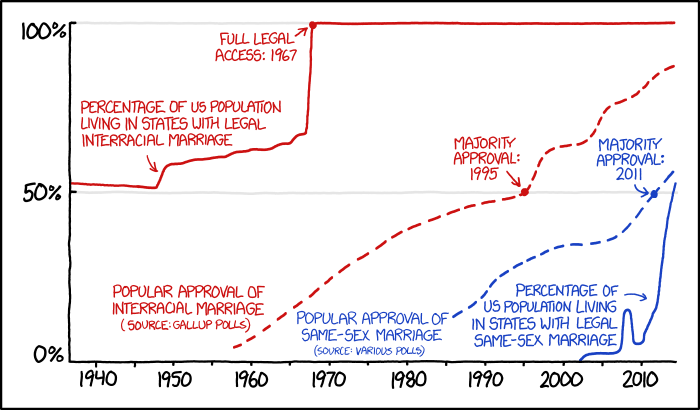
By early May of this year, several weeks before the Supreme Court decision, Gallup found 60 percent support in the U.S. same-sex marriage with only 37 percent opposed. This is a remarkable change. Just ten years earlier, in August 2005, the numbers were almost exactly reversed, with 37 percent in favor and 59 opposed. (For the May poll see this link. Historical polls are summarized in a table here.)
It’s interesting to compare this with the very similar trend line for public acceptance of interracial marriage, as shown in the graph below, originally published in the xkcd web comic last October:
Think about this: As recently as 20 years ago, barely half of Americans approved of mixed-race marriage, and yet it has been a long, long time since any American politician of any consequence, even in the deep South, has been willing to expresses so much as disapproval of interracial marriage, let alone call for making it illegal.
As the old saying goes, it’s dangerous to make predictions, especially about the future. (For the possibly Danish origin of that quotation often attributed to Yogi Berra, see this brief report.) But I’ll go out on a limb and say I’ll be surprised if same-sex marriage is still a significant issue in the 2020 presidential campaign or after. In fact, though it’s obviously something Republican candidates are talking about now, it might have largely faded into the background by the general election next year. (When was the last time you heard much about gays serving in the military?)
I would not, of course, expect religious acceptance to come as quickly as political. The Catholic Church in particular isn’t likely to change its stance soon, but then again, it still strongly disapproves of divorce, and of remarriage after divorce, and I don’t know of any Catholic politicians in the U.S. actively trying to make either illegal.
My previous post on that xkcd graph can be read here, and there’s more background, including recent updates, at the Explain xkcd wiki here. For more of my random musings, for whatever they’re worth, on public reactions to the Court’s decision see the posts here and here.
(Updated 2015 July 15 to add a suggestion that same-sex marriage might largely die out as a political issue before the 2016 election.)
It’s disturbing to realized that after making his recent stupid and offensive remarks about Mexicans, Donald Trump actually went up in polls of GOP voters and is near the top of the field. But we should remember that there are so many Republicans running for president that even the top-rated ones are barely in double digits, so it’s not like Trump has overwhelming support. His biggest advantage is name recognition.
Update (2015 July 15): Or maybe not. Steve Benen points out that a Washington Post-ABC News poll released July 15 shows Trump’s approval/disapproval rating among GOP voters has rocketed from 23/65 to 57/40 percent since a poll in late May. Keep in mind that this at the same time his offensive remarks about Mexicans have drawn widespread condemnation across the board, including from Republicans like Ben Stein, who has compared Trump to George Wallace “but without George Wallace’s charm” and said, “I can’t see him doing anything but damage to the Republican Party.” (Among the general public, the same latest WaPo/ABC poll shows Trump with 33/61 approval/disapproval now versus 16/71 in late May.)
Still, it’s useful to see Trump’s nonsense exposed, and Jon Stewart is the guy to do it:
This is one of Alfred Hitchcock’s best films, based on a popular stage play by Frederick Knot, who also wrote the script for the film.
Like its even better immediate successor, Rear Window, Dial M for Murder is set almost entirely in a single apartment. Both films also star Grace Kelly as a wealthy and beautiful woman. But while Rear Window is character-driven, has some interesting insights about human relationships, and takes place in Greenwich Village, the emphasis of Dial M for Murder is on the plot and a small handful of individuals, and the setting is London.
Kelly is married to former tennis pro Ray Milland. Robert Cummings is a visiting American mystery write who had an affair with her a year before. Hitchcock regular John Williams (the British actor, not the composer) plays a police inspector, and character actor Anthony Dawson is a con man blackmailed into committing murder. Everyone is quite good. I don’t want to say more about the plot because it’s full of entertaining surprises I wouldn’t want to spoil. For the same reason I’m omitting a trailer, though you can find one easily enough on line.
I think this was the only Hitchcock film produced in 3D, and he made good use of it in his compositions, though like most good 3D movies it’s fine in 2D as well (which is how I saw it). In fact, the only notable artifact of its having been a 3D movie is the fact that it has an intermission despite running only an hour and 45 minutes.
Even the largest projector reels in the 1950s held less than an hour’s worth of film, so a movie theater had two projectors in the booth, permitting the projectionist to switch seamlessly from one to the other at the end of each reel. But high-quality 3D projection required using both projectors at the same time in perfect synchronization, one for the left-eye image and one for the right, with polarizing filters on the projector lenses and corresponding ones in spectators’ 3D glasses. This necessitated a pause between reels to reload the projectors, hence the intermission in Dial M for Murder.
There was an alternative, cheaper single-projector process involving not polarization but different colors for the left and right images, but big-budget 3D movies then as now used polarization.
(Later advances allowed projecting both polarized images from a single projector and reel of film. Today 3D projection is digital, and the filters employ helical rather than linear polarization.)
Another consequence of shooting in 3D in the 1950s was that the camera rig would not allow extreme close-ups. Since Hitchcock wanted to show a very tight shot of a finger dialing a telephone at one point, the prop department had to build a giant telephone dial and a giant finger. They did so good a job that it’s hard to tell it isn’t real.


 by