John Green on Obamacare so far

The Patient Protection and Affordable Care Act, popularly known as “Obamacare,” was signed into law five years and one week ago. Here’s a compact seven-and-a-half-minute video clip assessing how well it’s working from prolific writer and commentator John Green, who incidentally buys his own coverage through the healthcare exhanges.


Link: http://youtu.be/wMuXcuudvCc

It’s worth clicking through to YouTube because the video’s description contains a bunch of links to additional information, making it an excellent reference on the subject.

If for some reason you can’t watch the clip, here’s my summary of what Green has to say:

  • Government spending alone on healthcare in the United States (not even counting private spending) is far higher per person than in such countries as Japan, the UK, or Australia. Total U.S. healthcare spending (public and private) is more than 17 percent of our economy versus less than 10 percent in France, Australia, the Netherlands, and many other developed countries with outcomes as good as or better than ours, and in those countries everyone or nearly everyone has insurance.
  • The U.S. has sort-of universal coverage for some things, such as emergency care, because if you go to a hospital you will almost always be treated for anything urgent. But if you can’t pay, the rest of us end up doing so through higher fees and taxes, which ends up being very inefficient. Moreover, it doesn’t cover treatment for chronic illnesses (which is one reason people die in the U.S. because they can’t afford care).
  • Prior to the ACA, insurance companies were allowed to turn people down for individual coverage if they had preexisting conditions (which even meant, in a specific case John mentions, ringing in the ears). This discouraged a lot of people from working for small companies or starting their own businesses.
  • On average, insurance premiums have been rising more slowly under the ACA than they were before, and it’s also costing the government significantly less than projected. (John doesn’t mention it directly, but the ACA is also lowering the federal budget deficit, and done so even more than it was expected to.)
  • Crackpot claims like “death panels” and “government takeover of healthcare” have of course proven false.
  • Aside from a few modest tweaks — insurance exchanges and premium subsidies for individual policies, no coverage denial, higher prices, or cancelation for preexisting conditions, and the like — very little has changed. We still have Medicare, Medicaid, the VA, and private insurance companies and doctors, as well as for-profit, non-profit, and county hospitals, and most people under 65 get coverage for themselves and their families through their jobs.
  • Has the ACA worked? Yes and no. Yes, many things are greatly improved, millions more people are insured, and there are even signs it has led to some overall improvements in health. But, no, it hasn’t led to universal coverage or the lower costs seen in other developed countries. Dealing with those problems would require bigger changes than the minor ones introduced by the Affordable Care Act.

Incidentally, a couple of years ago John did a video on why U.S. healthcare costs are so high. You can find it in this earlier post. He starts by saying this:

I want to talk today about why healthcare costs in the United States are so phenomenally, fascinatingly expensive, but first I have to blow your mind.

All right, so you’ve probably heard that the reason people enjoy quote-unquote “free” healthcare in Australia, in the UK, in Canada, etc. etc. is that they pay higher taxes. That money then goes into a big pot and is used to pay for people’s healthcare. But in fact, in the United States we spend more tax money per capita on healthcare than Germany, Australia, the United Kingdom, or Canada.

(More than other countries as well; see the video.)


Facebooktwitterredditpinterestlinkedintumblrmailby feather

Opportunity rover still exploring Mars after more than 11 years

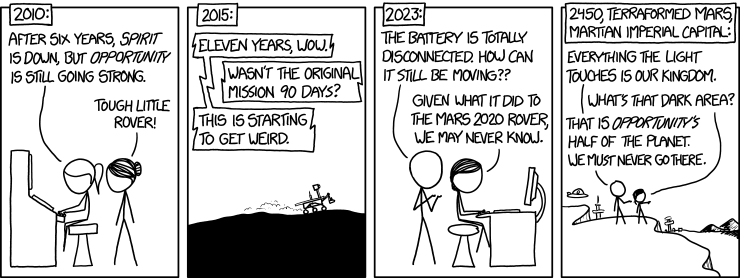
As today’s edition of the XKCD comic strip reminds us, the Opportunity rover has been exploring Mars since January 25, 2004 — way, way longer than the 90 (Martian) days it was originally designed for. The twin rover Spirit, which landed on Mars three weeks earlier, unfortunately got stuck in 2009 and ceased to communicate in 2010. But Opportunity is still at it, to the delight and amazement even of the engineers that designed it.

Comic about Opportunity's unexpectedly long lifespan and future conquest of Mars

For more on the Opportunity rover see its Wikipedia article (link) and the NASA Jet Propulsion Laboratory pages on Mars rovers (link) and Mars rover news updates (link). See also the Explain XKCD page about the strip (link).


Facebooktwitterredditpinterestlinkedintumblrmailby feather

Educational version of Minecraft game in Northern Ireland secondary schools

As you probably know, Minecraft is a versatile and creative video game from Sweden that allows players to build virtual worlds out of blocks or go on adventures in worlds created by others. An organization based in Finland called Minecraft EDU promotes using Minecraft in education. The British Museum is creating a Minecraft version of itself, and Denmark has created a Minecraft virtual version of the entire country.

Northern Ireland has announced the introduction of Minecraft for education in all the country’s secondary schools and many public libraries and similar institutions, and they’re inviting other educational organizations to join in all across the world, as described in this video (a little over two minutes long):


Link: http://youtu.be/SNjdQ6KqDlE

For more on Minecraft, see its Wikipedia article (link).


Facebooktwitterredditpinterestlinkedintumblrmailby feather

Changing religious beliefs in the United States

Ever since 1972 the General Social Survey has polled adult Americans’ opinions on a variety of subjects using in-person interviews. The latest results, based on a survey conducted in 2014, have recently been released, and they’re quite interesting. The Associated Press has a good overview at this link, and the report itself can be found here. (That page is a brief summary with links at the right to PDF and HTML versions of the full report.)

The number of those surveyed who don’t identify with a specific religion has reached a new high of 21 percent, up from just 5 percent in 1972. Moreover, only 70 percent express belief in an afterlife, and only 58 percent in God. But on the other hand, just 3 percent are explicitly atheists and another 5 percent agnostics. I suspect one reason for the seeming discrepancy is that for many people, including a fair number of those who consider themselves members of a particular religious denomination, religion just isn’t a major part of their lives or something they think about very much.

On a related public policy front, for the first time the General Social Survey finds majority support for same-sex marriage, with 56 percent agreeing that same-sex couples should have the right to marry versus only 32 percent who disagree. Among those aged 18-34, support for same-sex marriage is 72 percent.

The GSS covers a lot of other topics as well, so do take a look at the links above.


Facebooktwitterredditpinterestlinkedintumblrmailby feather

Review: Charlie Chan in Egypt (1935 movie)

Charlie Chan has been hired by a French scientific organization to investigate sales to the collectors market of artifacts from a tomb whose excavations they had funded, and in the course of things he discovers that the body of a murdered archaeologist has been concealed as an ancient mummy. (An X-ray reveals that the mummy had died from a gunshot, which naturally arouses his suspicions.)

The film is painfully dumb, with none of the witty dialog seen in better films of the series. Stepin Fetchit is around for alleged comic relief in a role that isn’t just a cringe-provoking racial stereotype but even has him speak of having been “won” at gambling by one of the supposed good guys, who thinks nothing of striking Fetchit for moving too slowly for him. It’s really painful to watch.

(Mantan Moreland played a similarly comic role in other Charlie Chan films but was for my tastes nowhere remotely as offensive, and in fact created some of the comic bits in them himself. For examples, see this earlier post.)

In fairness to Fetchit, real name Lincoln Perry, his “Laziest Man in the World” character was hugely popular with audiences, so much so that he was the first black actor to get starring credit in films and the first to become a millionaire. Very different in real life from his screen roles, he was close friends with Will Rogers and wrote regularly for The Chicago Defender, a major African American weekly newspaper. His Wikipedia article (link) has more on his life and career. And to belabor an obvious point, he can’t be blamed for this film’s lousy screenplay.

While I can’t recommend the film, one of the extras on the DVD is worth seeing: a short documentary about an early-20th-century Hawaiian police detective named Chang Apana (1871-1933). Detective Chang was not well educated, but he was fearless, incorruptible, and much admired. At one point he single-handedly arrested 70 people in a gambling den using nothing but the force of his authority and reputation. Like Indiana Jones, his favored weapon was a whip, and he was called on to demonstrate tricks with it on numerous occasions. Chang was sometimes said to have been the inspiration for Charlie Chan, and in later years people even took to calling him Charlie Chan, but he had little in common with the character besides being a Hawaiian detective of Chinese ancestry. For more about him see his Wikipedia article (link), which says that Chang enjoyed the Charlie Chan films and met Warner Oland, the Swedish American actor who played Chan in 16 of the movies, during the filming of The Black Camel on location in Hawaii.

Charlie Chan’s creator, Earl Derr Biggers, reportedly read about Chang while vacationing in Honolulu in 1919, and this might have given him the basic idea for the character. But Chang and Chan did not much resemble each other in physique or personality. According to Bigger’s wife, Chan’s physical description in the novels was pretty close to that of the author himself, not the cop. Incidentally, Charlie Chan spoke standard English in the books. The exaggerated accent was an invention of the movies. Pretty much the same thing happened to Tarzan.

I wasn’t able to find a trailer for Charlie Chan in Egypt, but you can find the whole film on YouTube if you want to see if it’s as bad as I’ve described. To be fair, not everyone agrees with my low opinion.

(Updated 2016 September 12 to correct a typo and clarify some wording in a couple of places.)


Facebooktwitterredditpinterestlinkedintumblrmailby feather

Here’s why heavy winter snows don’t say anything about global warming

I was recently in a conversation with someone who suggested that this winter’s heavy snows in the eastern U.S. had “proved Al Gore wrong” or words to that effect. The person who said this isn’t especially interested in science but is not at all dumb, and the idea is probably fairly commonplace. In fact, a couple of weeks ago Senator James Inhofe (R-Oklahoma) brought a snowball to the Senate floor to make the same point. He was widely mocked for doing so, but I don’t recall anyone taking time to say actually why the notion is misguided (aside from pointing out that other parts of the U.S. have been unusually warm this year, and the most recent winter is probably the hottest on record globally).

So I thought I’d try my hand at a very brief explanation.

To start with, “global warming” doesn’t mean the globe is warm, only that the average global temperature is rising. Over the past 250 years the Earth’s temperature has risen about 1.4 degrees Celsius (2.5 Fahrenheit). The rise for the past 100 years has been 3/4 of a degree Celsius (1.3 Fahrenheit). Obviously a difference that small isn’t going to keep it from snowing.

In fact, I suspect most people’s reaction to this would be to wonder why in the world anyone would make a fuss about such a modest rise in temperature, given that it varies a lot more than that from day to day. So what’s the big deal?

It’s because we’re talking about a long-term average, not short-term fluctuations about that average. There’s a lot of evidence that the average had held very steady for many centuries before the current warming trend. Moreover, the rate of change is accelerating, heating up twice as fast in the last 50 years as in the previous 50. The current rate of warming may be unprecedented in thousands or even millions of years.

The climate has changed in the past (if usually not this fast), but geology and paleontology suggest that when the global average temperature has risen or fallen by a few degrees, the results have been pretty dramatic. To be more specific, a lot of research suggests that a further increase of more than a couple of degrees Celsius would lead to serious harm. In fact, we’re already starting to see some of the anticipated problems. For example, biologists are reporting troubling developments attributable to warming, such as the expansion of tropical diseases and pests into more areas and shrinking habitats for cold-weather plants and animals. Several island nations in the Pacific and cities in south Florida are experiencing increased flooding as a consequence of sea-level rise.

The surface temperature is only a small part of the story. In fact, the great majority of the heat is being absorbed by the oceans. It’s thermal expansion that’s causing those rising sea levels. Warmer oceans also lead to more evaporation, meaning we can expect more rain and more snow in many areas where the air cools enough to precipitate out the moisture it holds. (So much for the idea that more snow means no global warming.)

This isn’t just a problem for polar bears. It’s a serious menace to the world’s economy and the health of humans, plants, and animals, including those important to agriculture. Unless something is done soon, sea level rise and these other problems will likely force massive human migrations later in this century, leading to political disruption and war.

More directly, a higher average temperature means more heat waves. It surprised me to learn a few years ago that heat waves are the single most deadly weather phenomenon, killing far more than hurricanes, tornadoes, or floods.

I’m trying to keep this brief, so I’ll just list a few earlier posts on the subject that might be of interest:

  • Physicist and former global warming skeptic Richard Muller describes his research and why the data forced him to change his mind (link)
  • 2014 was the warmest year on record according to multiple independent sources (link and link)
  • Astronomer Phil Plait’s suggested recent reading/viewing viewing on global warming (link)
  • White House science advisor John Holdren corrects misconceptions from members of Congress (link)
  • More misconceptions are addressed by the Veritasium science channel on YouTube (link)
  • A survey of U.S. scientists finds overwhelming agreement that humans are causing climate change (link). In addition, if you look at the detailed report (link to PDF, see page 77), only 9 percent think the temperature rise is mostly from natural causes and just 3 percent doubt the Earth is warming. In addition, 94 percent consider it a serious problem, with more than 3/4 calling it “very serious.”

(See also the climate change category in the right column for additional links.)

Finally, in passing, it’s probably worth mentioning Al Gore didn’t invent the idea of global warming any more than Margaret Mitchell made up the Civil War when she wrote Gone with the Wind. Gore just offered a book, a movie, and a series of speeches about a subject that has been widely accepted science for decades. I first learned about human-caused global warming when I was a physics major in college, and years before that it was mentioned in one of the Bell Telephone television science specials back in 1958. (I included a clip from that show at the end of this earlier post.)

(This post has been updated a couple of times for clarity.)


Facebooktwitterredditpinterestlinkedintumblrmailby feather

Review: Man of Steel (2013 movie)

While it was directed by Christopher Nolan, who previously did the Dark Knight series of Batman films, this is basically what you’d get if J.J. Abrams made a Superman movie, complete with something that resembles the planet-wrecking gizmo in the first Abrams Star Trek film.

Superman’s biological father Jor-El (Russell Crowe) isn’t just a scientist concerned with Krypton’s impending destruction, he’s pretty much Krypton’s version of Batman, though he also rides a flying reptile like the kid in How to Tame Your Dragon, and as a bonus comes back as a posthumous AI version of himself something like Marlon Brando in the 1980s Superman films.

Much of the plot is a scaled-up rehash of 1980’s Superman II. There are lots and lots of impressive fight scenes between super-powered Kryptonians on Earth, with horrific resulting wreckage that starts off with major potholes and laundromat damage in Smallville and builds to the demolition of most of downtown Metropolis with horrendous loss of life, though nobody seems all that upset about collateral damage unless the party being menaced is somebody we happen to know. That may be a bit of an exaggeration, but only a bit.

The character of Lois Lane could have been better written and better cast (though I’m otherwise a huge fan of Amy Adams), but there’s a quite nice twist on her suspecting Clark Kent of being Superman, and she gets the film’s best line at the end.

Henry Cavill, who plays Superman, gets the other good line a few minutes earlier. Otherwise the story has him brooding so constantly you might wonder if he’s limited to just one facial expression, like Grumpy Cat. I’ve read that the filmmakers concocted scenes to show him shirtless because he’d worked very hard on to achieve his physique and they didn’t want people to think the muscles were built into the suit. Those scenes didn’t do anything for me (except to make me think briefly about resuming my physical therapy), but tastes differ.

I didn’t hate Man of Steel and it does have its moments, but I don’t particularly recommend it.


Link: http://youtu.be/T6DJcgm3wNY


Facebooktwitterredditpinterestlinkedintumblrmailby feather

Review: Moving Pictures by Terry Pratchett (1990 novel)

Alchemists influenced by eldritch forces discover the secret of making movies and this proves popular enough with the public that there are soon multiple movie factories grinding out product in a Holy Wood. Notorious Ank-Morpork sausage vendor Cut-Me-Own-Throat Dibbler manages to take over the management of one of them, called Century of the Fruit Bat Studios.

But there are signs of a hidden menace. A gorgeous blond actress starts having visions of a mysterious figure, a sort of shining knight holding a huge sword (posed like an Oscar, in fact) who might be a threat or might be a guardian. The wizards at Unseen University detect a sudden flood of unreality leaking into the world. Eventually the unreality becomes so powerful that a giant projected image of the actress steps off the screen and is soon climbing the University’s Tower of Art, the tallest building in Ank-Morpork, clutching the University’s Librarian, who happens to be an ape, in one hand.

As usual with Pratchett it’s funny and entertaining, and there are scads of movie references, including some I no doubt didn’t notice. Probably not the best Discworld novel, but fun.

As noted in a post yesterday (link), Terry Pratchett is no longer with us. He died at home in bed with his family around him, as he had wanted to do.


Facebooktwitterredditpinterestlinkedintumblrmailby feather