Review: War Dogs (2016 movie)

The main characters really existed and really did most of this stuff in the early years of the wars in Iraq and Afghanistan.

David Pakouz (played by Miles Teller) was a 20-something massage therapist barely scraping by in Miami Beach. He hoped to do better by selling a stock of quality bedclothes at a discount to old folks homes, but he learned that the owners weren’t interested in quality. (The real Pakouz has a cameo as a singer entertaining the residents at one of the retirement homes.)

But then he runs into an old school chum, Efraim Diveroli (Jonah Hill), at a funeral, and Hill turns out to be making a very healthy income bidding on arms contracts via a Pentagon website, aiming for smaller deals that the major players overlook. Diveroli is busy enough to need a partner, so he brings Pakouz into the business and soon he’s no longer worrying about money.

But then they face a crisis trying to deliver a supply of Berettas for the Iraqi police, and since a failure would kill their chances for future contracts, they wind up personally trucking the guns into Iraq and nearly getting themselves killed. But they survive, and they’re able to make even bigger deals that are increasingly shady. Meanwhile Pakouz gradually catches on that Diveroli’s lies aren’t limited to the ones he tells other people.

The story reminds me of Elmore Leonard novels, in which people tend to believe themselves to be a lot more clever than they really were.

The acting is quite good and the writing decent, but as a fact-based comedy crime drama it’s only occasionally funny and I found it often depressing. That’s a matter of taste, though, and others enjoyed it a lot more than I did.


Link: https://youtu.be/Rwh9c_E3dJk


Facebooktwitterredditpinterestlinkedintumblrmailby feather

Review: Captain America: Civil War (2016 movie)

As everybody says, this is really an Avengers movie, though Captain America is the protagonist, and like the previous Captain America film it touches intelligently on some serious subjects, including unintended civilian deaths and whether dangerously powerful superheroes should act as free individuals or be subject to some sort of government control. Disagreement about the latter leads to a split in the Avengers, with Steve Rogers (Captain America) on one side and Tony Stark (Iron Man) on the other.

There are also a lot of funny bits, and Ant-Man and Spider-Man show up as well.

This version of Spider-Man is back to being a high school student who lives with his Aunt May, but not the very elderly Aunt May of the comics. This Aunt May is played by Marisa Tomei, looking as attractive as I’ve ever seen her, which is attractive indeed. When Tony Stark (Robert Downey Jr) meets her his reaction is pretty much the same as mine: “You know, I’m having a hard time believing she’s someone’s aunt.” He can’t shut up about it.

I enjoyed it, but if you haven’t seen at least some of the films leading up to this one you might be lost.


Link: https://youtu.be/dKrVegVI0Us


Facebooktwitterredditpinterestlinkedintumblrmailby feather

Bernie Sanders reflects on the election with Stephen Colbert

A few days after the 2016 election, Senator Bernie Sanders appeared on The Late Show with Stephen Colbert and made some thoughtful comments about goals for the Democrats and the future.

At the time it wasn’t clear what Trump would do as president. Sanders held out hope he might do some positive things, seriously trying to create jobs and raise wages, for example.

But mainly he made the point that Democrats have neglected the concerns of a lot of working Americans, and that’s something the party needs to change. It would in fact be a return to the party’s position in the middle decades of the 20th century, when the country made a lot of progress. Not only did the economy grow rapidly, everybody shared in the growing wealth, not just those who were already well-off.

This was also the era of civil rights, of improving the environment, of providing health care to the poor and elderly with Medicaid and Medicare, and of going to the Moon. Obviously things were nowhere near perfect — nothing ever is — but there was a lot of reason to hope.

Trump attracted a lot of voters, especially older voters, by raising hopes. Unfortunately those hopes were based on empty slogans (combined with lies and scapegoating) rather than realistic plans and proposals. Democrats can and should do better. You don’t have to be a devoted Bernie fan to appreciate the sense of a lot of what he has to say here.

One update to what Senator Sanders says below: In the final tally, Hillary Clinton’s margin of victory in the popular vote was nearly 3 million, about 2.9 percent of votes cast.


Link: https://youtu.be/hyTwoBIo8kQ


Link: https://youtu.be/vf_XrfpdOsM


Facebooktwitterredditpinterestlinkedintumblrmailby feather

Review: Miss Peregrine’s Home for Peculiar Children (2016 movie)

This is something like a mix of the X-Men and Harry Potter. Asa Butterfield plays a troubled kid who grew up hearing tall tales from this grandfather (Terence Stamp) about spending World War II in a Welsh orphanage whose residents all had strange abilities. When his beloved grandfather dies in a mysterious and horrific fashion, Butterfield is traumatized, but he gradually recovers and eventually persuades his father to take him to the town in Wales so he can see the children’s home for himself, in the hope this will help him achieve closure.

What he really wants to do is find out whether his grandfather’s stories were true. When they get there they learn that the children’s home was destroyed during the war. But Butterfield slips away to explore the ruins by himself and encounters some of the strange children his grandfather had spoken of, who don’t appear to have aged.

It transpires that there are always peculiar children in the world and adults to protect them, as well as powerful others who want to harm them.

The film, directed by Tim Burton, is visually striking, and the script, Jane Goldman’s adaptation of the novel by Ransom Riggs, is full of interesting ideas. I liked the film well enough, though I thought it seemed a little too self-consciously strange.

Incidentally, screenwriter Goldman (no relation to William Goldman), along with her frequent collaborator Matthew Vaughan, previously adapted Neil Gaiman’s novel Stardust for an excellent 2007 film that ought to be better known. They also wrote Kick-Ass and X-Men: First Class. On her own Goldman scripted The Woman in Black, a memorably spooky ghost story starring Daniel Radcliffe.


Link: https://youtu.be/DN1uhnnKscY


Facebooktwitterredditpinterestlinkedintumblrmailby feather

Trumpcare

Updated 2017 March 28: Despite a number of last-second amendments added in a failed effort to attract support from the far-right House Freedom Caucus, opposition to the Trumpcare bill continued to grow and the vote was postponed Thursday and canceled Friday. Since then some Republicans have suggested the bill will be revived but others (including Senate majority leader Mitch McConnell) have said that this will not happen. I’ve updated the post below to correct some typographical errors, and it might still be worth reading for reference to recall how bad the proposal really was even according to Republican assessments.

On Thursday the U.S. House of Representatives is (or was) supposed to vote on the American Health Care Act, which if enacted would drastically increase health insurance premiums for many poorer and middle-aged Americans, and in a year or two would end Medicaid eligibility for millions more. The Congressional Budget Office, incidentally now headed by a Republican, estimates that in 2018 alone 14 million Americans would lose health insurance coverage they now have, and by 2026 that would rise to 24 million in comparison with the number of uninsured under the Affordable Care Act. (A PDF of the full report can be found here.)

According to press leaks, the administration’s own internal report estimated that even more people would lose coverage than the CBO projected. (The White House didn’t deny that, but said it was just their guess of what the CBO would estimate.)

Defenders of the bill point out, rather misleadingly, that the CBO report also says that premiums will eventually go down. Actually, it says that premiums will go up in the short run, after which they would indeed go down — but only because policies would offer less coverage and because so many Americans in their 50s and early 60s would be priced out of the market that the the pool of insured persons would on average be younger and eligible for lower premiums simply because of their age.

How much would insurance costs go up under the Republican plan? According to the CBO, a 64-year-old making $26,000 a year and buying his or her own insurance would on average see the annual premiums rise from $1,700 under the current law to $14,600 under the Republican proposal — 56 percent of that person’s gross income.

The bill is opposed by the American Medical Association, the American Hospital Association, the American Nurses Association, many consumer groups, the AARP, Democrats from the most centrist to the most liberal, moderate Republicans in the Senate, and moderate and far-right Republicans in the House. But with enough pressure from Paul Ryan and Donald Trump, it might pass the Republican-controlled Congress anyway. (The bill is intended to conform to a Senate rule that would allow it to avoid a filibuster.)

Here’s a very quick comment (just over a minute) from Comedy Central’s The Daily Show about the bill captured during a break in shooting the program:


Link: https://youtu.be/pcKNxA8AF4E

More seriously, here’s pediatrician and medical school professor Sean Carroll MD summarizing the key points of the CBO’s report:


Link: https://youtu.be/FS2quDy2KS8

Here’s more commentary — informative and funny — from The Daily Show:


Link: https://youtu.be/1hug1qbpbAw

Finally here’s John Oliver’s take from the before the CBO had a chance to score the bill. It’s still pretty informative and funny. (Note that this is from HBO’s Last Week Tonight, so there are a few unbleeped naughty words.) Apologies for putting so many videos in one post, but I thought it might be useful to have them all in one place for reference.


Link: https://youtu.be/Ifi9M7DRazI


Facebooktwitterredditpinterestlinkedintumblrmailby feather

Review: Goosebumps (2015 movie)

R.L. Stine is an author best known for the “Goosebumps” series of children’s horror novels originally published in the 1990s and popular for their scares, plot twists, and flashes of humor. Stine’s books have outsold Stephen King’s, at least if you go by the number of books and not by their collective mass.

The movie opens with the young protagonist (Dylan Minnette) and his mom arriving in their new home. She has just been hired the assistant principal of a a high school, and he will be a student there. Being both the new kid and the son of the assistant principal doesn’t exactly make Minnette instantly popular, but he’s soon befriended by an awkwardly earnest nerd (Ryan Lee) who’s a bit of an outcast himself, though he’s basically a nice guy.

He also meets the appealing and self-confident girl next door (Odeya Rush), who looks a bit like a young Mila Kunis and is being home-schooled by her hyperprotective father, Jack Black. Black doesn’t want his daughter talking to any boys, or to anybody at all for that matter. But she sneaks out at night to go exploring and invites Minnette to come along so she can show him her discoveries, including an abandoned amusement park.

We soon learn that Black is actually R.L. Stine, and he has good reason to be secretive and protective: His horror creations have been coming to life and plotting to destroy him and anyone close to him. Actually they would like to destroy pretty much everybody else, too, but Stine and associates are at the top of their list, since he wants to stop them. (You could say they’re not on the same page.)

Meanwhile the high school’s obnoxious principal has the hots for the hero’s mom, the hero’s nerd friend has the hots for any girl who might conceivably be interested in him, the hero’s mom’s sister has the hots for any available man, and the town’s tiny police force includes an enthusiastic trainee cop who has the hots for arresting somebody, anybody, or at least tasing them.

It’s an unexpectedly entertaining movie, with a plot that moves right along with some interesting surprised. The monsters aren’t particularly scary, but given the intended family audience, that’s not necessarily a bad thing.

The real R.L. Stine has a very brief cameo in which he greets Jack Black as “Mr Stine” and Stine calls him “Mr Black.”

If you’re looking for a film to watch with a grandkid, niece, nephew, or whatever, this wouldn’t be a bad choice. You might well even enjoy it on your own. I did.


Link: https://youtu.be/7Cn716jv61s


Facebooktwitterredditpinterestlinkedintumblrmailby feather

Boston public schools embrace bad mapmaking

The Boston Public Schools have embraced a bad map projection, specifically Gall-Peters. The so-called Peters projection is promoted as “more accurate,” but this is at best misleading. Even The Boston Globe, in most respects a pretty good newspaper, neglects to mention the serious problems with Gall-Peters in its article on the Boston Schools decision here. (And that, mind you, is from a newspaper that’s actually named after the globe!)

All rectangular maps (technically cylindrical projections) in actual use — including Gall-Peters and Mercator — necessarily distort east-west distances: They represent all parallels of latitude as equal in length, which of course they’re not. For example, the equator is 21,600 nautical miles in circumference, while the 60th parallel north or south (roughly the latitude of Anchorage, Alaska) is only half as far around. All world map projections of this sort necessarily stretch out horizontal distances the farther you get from the equator, and they do so to the same degree. They differ only in how they scale distances north and south.

The Mercator projection makes the vertical scaling the same as the horizontal at any point. This does a pretty good job of representing shapes of all but the largest countries and regions, as you can see by comparing a Mercator map with a globe. It also preserves compass directions, and within small areas it comes close to representing the relative distances between points.

Of course, it also famously distorts relative areas on a global scale, for example making Greenland look as big as Africa though Africa is more than an order of magnitude larger. There’s no question that students need to understand that, and that for many purposes the Mercator projection isn’t the best choice for world maps used in classrooms.

But Gall-Peters is a bad choice as well. It does get one thing right. By stretching things vertically toward the equator and squashing them near the poles it correctly shows area relationships. The basic idea is to select a reference latitude north and south (typically 45 degrees) where the vertical and horizontal scaling is the same, but to exaggerate north-south distances closer to the equator and compress them toward the poles in a way mathematically calculated to create a constant scaling for areas.

Unfortunately, correctly representing relative areas on a rectangular map ends up pretty severely distorting literally everything else. Fortunately there are other equal-area projections that are less distorted.

Even better for classroom use, there are projections that achieve a reasonable compromise between representing shapes and representing distances and areas. The National Geographic Society, for example, uses the Winkel-Tripel projection, and Rand McNally uses the Robinson. These projections don’t try to stretch the round Earth into a rectangle. Those projections do result in curved lines of longitude, but since we’re used to looking at curved surfaces, our eyes more easily compensate for these distortions than for the weird stretchings and squashings of cylindrical projections.

To belabor the obvious, globes are better than any flat map and belong in every relevant classroom, or at least in every school. Not only do they get shapes, distances, and areas right, they also make other things clear that it’s all but impossible to figure out from a map. For example, with a globe it’s clear that the shortest distance between two points is rarely a line of constant compass direction. It’s hard to see from a flat world map why a flight from the United State to Europe crosses over the arctic, but it’s obvious from a globe.

Wikipedia has a pretty good list of map projections. The XKCD comic strip below shows some well-known (and not so well-known) ones together with amusing commentary. (For an explanation, see Explain XKCD.)
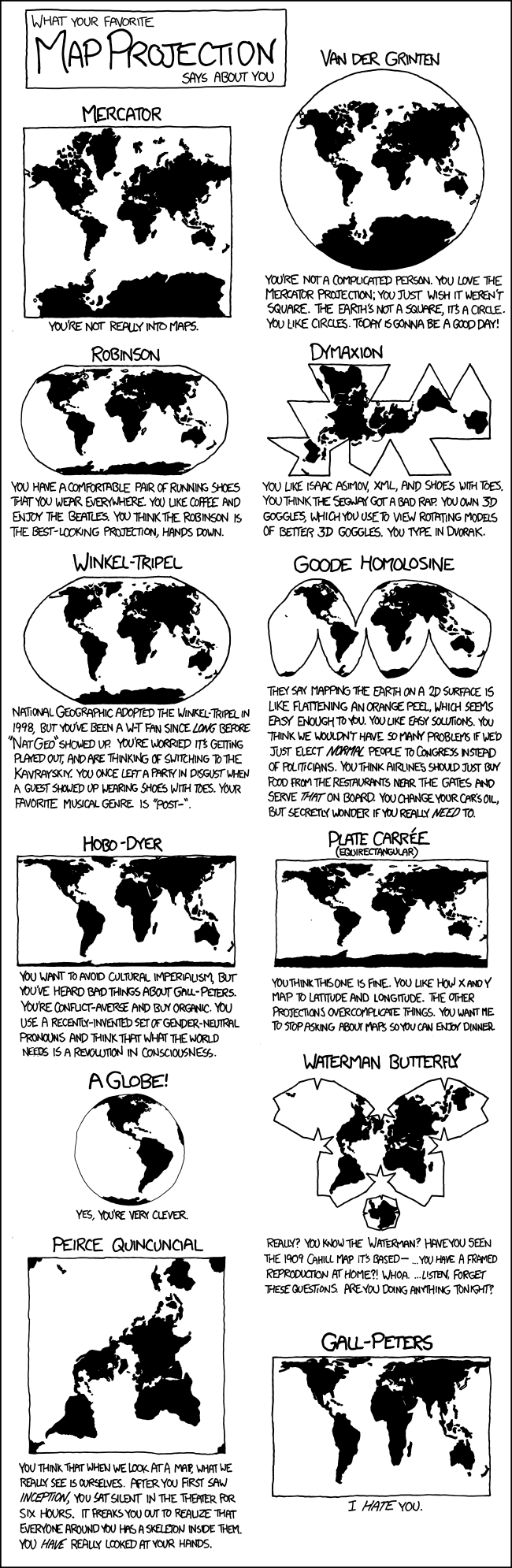
XKCD \

(Updated 2017 March 28 to correct at least some of my usual typos and to try to improve wording.)


Facebooktwitterredditpinterestlinkedintumblrmailby feather

Saw puppet gets fast food

In the latest drive-thru prank from Rahat, the evil puppet from the Saw movies goes to several fast food places in search of tacos, burgers, and chicken nuggets. As usual the reactions range from amusement to shock to both at once. Reasonably funny:


Link: https://youtu.be/NAxMewFqiNQ

Here’s a compilation of Rahat’s best bits from last year, not all at the drive-thru, and not all winners. I particularly like the enchanted frog prank, in which a stuffed frog sitting on a park bench tells passing women that he’s an enchanted prince and persuades quite a few of them to kiss him, leading to their astonishment when the frog vanishes in a cloud of smoke and is replaced by a prince complete with crown. (Once woman still suspects the witch who transformed him into a frog did so with good reason.) Fair warning, though: While most segments are at least reasonably amusing some seem rather pointless or even downright inconsiderate and unfunny or even dangerous.


Link: https://youtu.be/nHx8yBINUUc


Facebooktwitterredditpinterestlinkedintumblrmailby feather

Review: Doctor Strange (2016 movie)

My friend Bryan Jones has said that Benedict Cumberbatch looks like he was drawn by Steve Ditko — the artist behind the original Doctor Strange comics — so he was natural choice for the role.

Early in the film Dr Stephen Strange is a brilliant neurosurgeon (just ask him) but a bad driver, leading to an accident that smashes his hands. Since his only other skills are typing, needlepoint, and guitar, this leaves him with little to do but feel sorry for himself. He does, on the other ha—

He does, however, have a lot of money, so he devotes himself to looking for a cure, eventually winding up at a mystical academy in Kathmandu Nepal run by a hairless Tilda Swinton, and after some difficulties with the admissions process he’s allowed to study there. He proves to be a gifted student and an under-appreciated class clown, sarcasm not being covered in the syllabus.

The casting of Swinton has provoked a lot of criticism, but the filmmakers had decided they would get complains no matter what they did. In particular, making the Ancient One an aged Asian as in the comics would likely have been criticized as a racist cliché.

There’s nothing particularly profound here, but it’s a fun movie with excellent special effects and a nice sense of humor.

Incidentally, any time I think of Kathmandu I’m reminded of a National Geographic article on the country from a few decades back. The photographs showed a beautiful alien landscape and buildings of decidedly exotic architecture. In one especially memorable image of a street scene there is a sign fixed to a pole with the hand-lettered words “New York Style Pizza” over an arrow pointing the way.


Link: https://youtu.be/HSzx-zryEgM


Facebooktwitterredditpinterestlinkedintumblrmailby feather