How U.S. access to medical care stacks up against other countries

By multiple measures, U.S. access to medical care lags behind that in other developed countries. Pediatrician and medical school professor Aaron Carroll talks about that here:


Link: https://youtu.be/RyWsga1P3VQ

For more on this, see Dr Carroll’s article in The New York Times from last October.

Yes, I’m a little late posting this, and for that matter Carroll is talking about research conducted several years ago, but it’s still relevant today. In fact, just a few weeks ago I gave up getting an appointment to see my primary care doctor and wound up going to an urgent care clinic.

There seem to be more and more of these, some of which even specialize (for example, in orthopedics and sports injuries). Even drugstores and discount retailers have clinics, often staffed by nurse practitioners or physician assistants. Carroll has mentioned these in the past, and do they help make up for the shortage of primary care doctors as well as providing an alternative to going to the emergency room with something that isn’t a real emergency.

A walk-in clinic isn’t a perfect substitute for a primary care doctor you can see on short notice. There’s a lot to be said for seeing a doctor who knows you and has access to your medical records, and who can update those records to reflect your latest illness. A bit of good news is that more and more often doctors are affiliated with medical centers and accountable care organizations that have a shared medical records system and very likely one or more urgent care clinics. Unfortunately there’s no guarantee that all your doctors will talk to each other. The large orthopedics practice I visited a few weeks ago seems to have an excellent medical records system, but it doesn’t talk to the one used by my primary care doctor’s practice, which is part of Duke University’s healthcare system. Neither of them talks to my dermatologist or my optometrist or my dentist as far as I know.

France seems to have solved this problem, but we’re still working on it.


Facebooktwitterredditpinterestlinkedintumblrmailby feather

U.S. medical spending

The April issue of AARP Bulletin has an interesting chart (which unfortunately doesn’t seem to be available on line) breaking down healthcare spending in the United States in terms of where the money comes from and where it goes.

A large fraction of the total is paid for by government programs. Medicare, Medicaid, the Veteran’s Administration, military medical care, and public health programs account for nearly 45 percent of the total. Most of that is federal, but states contribute a significant fraction as well, especially on public health and their share of Medicaid.

Private health insurance companies pay for 33 percent of total healthcare spending, ultimately financed by premiums paid for by businesses, individuals, and government subsidies. Another 11 percent is paid for by patients and their families out of pocket. The remainder comes from a variety of other sources.

Almost a third of spending goes toward hospital care. Doctors and clinical services account for 20 percent and prescription drugs for 10 percent. Nursing home care is just 5 percent and home healthcare 3 percent. Dental services account for 4 percent. Medical equipment and supplies, research, and various other smaller categories collectively account for a little over a fourth of spending. Insurance overhead is 8 percent, which is a lot in dollar terms, but even if it were zero, that wouldn’t reduce total spending all that much.


Facebooktwitterredditpinterestlinkedintumblrmailby feather

An interesting difference between Democratic and Republican perceptions

Years ago I read about an experiment to see whether college students were receptive to supposed evidence (in reality made up for the study) contradicting their existing beliefs (credulous or not) about paranormal phenomena. Skeptics proved more willing than believers to change their minds, something that might surprise those imagining skeptics to be closed-minded. But the skeptics also tended to be fans of science, and the founding principle of science is basing conclusions on evidence.

I was reminded of this when reading about some recent polling results that have nothing to do with paranormal activity but plain old politics and the economy.

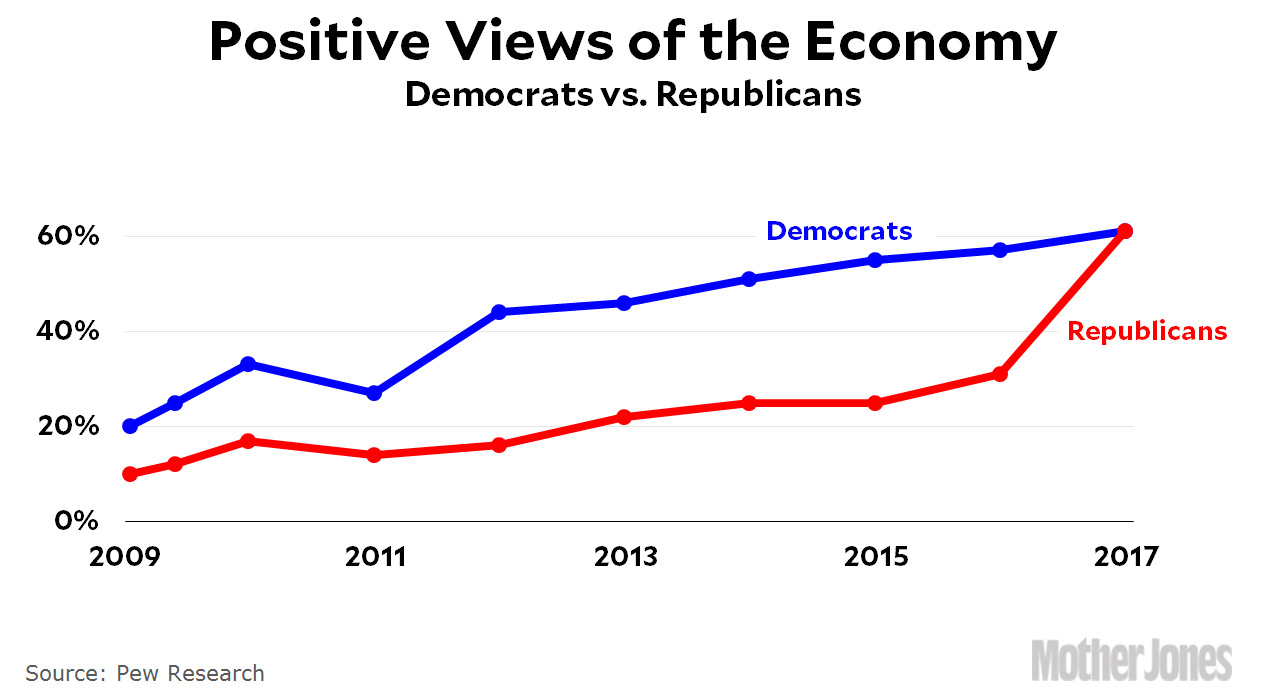
Back on April 5 Kevin Drum pointed out that since the financial crisis of 2008, a growing percentage of Americans, including both Republicans and Democrats, have rated the state of the economy as “good.” This is based on a Pew Research survey) conducted every spring. But until recently a lot more Democrats than Republicans rated the economy as “good”:

Here’s the interesting part. It’s normal to assume that people think better of the economy when one of their own is president. But is it true? During the recovery from the Great Recession, Republicans consistently rated the economy worse than Democrats. When Trump took over, their views suddenly skyrocketed, with a full 61 percent now having a positive view of the economy. Apparently Republicans do indeed view the economy through a partisan lens.

If Democrats followed that pattern, their view of the economy would have plummeted in 2017. But it didn’t. It went up again, at about the same rate as previous years. Democrats, it turns out, don’t view the economy solely through a partisan lens.

In another blog post April 14 Drum referenced a similar partisan difference noted by Jeff Stein at Vox: The number of Democrats favoring air strikes on Syria is essentially unchanged since 2013 according to Washington Post polling, 38 percent then and 37 percent now. (In both cases the Syrian government had recently been accused of using poison gas against civilians.) But Republican support for air strikes jumped from 22 percent in 2013 when Obama was president all the way up to 86 percent now. Breanne Deppisch of The Washington Post and Steve Benen of MSNBC made similar points.

Craig Gilbert of The Milwaukee Wisconsin Journal Sentinel published an article April 15 that underscores particularly sharply the partisan difference in perception.

Trump’s election did more than change the expectations of Republicans and Democrats about the economy’s future performance.

It altered their assessments of the economy’s actual performance.

When GOP voters in Wisconsin were asked last October whether the economy had gotten better or worse “over the past year,” they said “worse” — by a margin of 28 points.

But when they were asked the very same question last month, they said “better” — by a margin of 54 points.

That’s a net swing of 82 percentage points between late October 2016 and mid-March 2017.

What changed so radically in those four and a half months?

The economy didn’t. But the political landscape did.


Facebooktwitterredditpinterestlinkedintumblrmailby feather

Rahat’s drive-thru Elmo prank

I’m not sure what it says about my taste that Rahat’s drive-thru pranks continue to amuse me. A lot of them are pretty funny and they’re generally pretty harmless, though I feel a little bad about the occasional person who seems genuinely scared out of his or her wits.

Many of the pranks are based on a fake seat back behind which Rahat can sit and drive the car (at least enough to navigate a fast-food drive-thru lane) while the apparent driver is a skeleton, a robot, a teddy bear, a puppet, or nobody at all. Reactions range from fright to hilarity. This time the mystery driver is Elmo from Sesame Street. You’d think this would produce mainly “Awwww”-type reactions, but apparently for some people Elmo is the stuff of nightmares:


Link: https://youtu.be/RUPo6qhU-Nw


Facebooktwitterredditpinterestlinkedintumblrmailby feather

At least Trump is learning on the job

A lot of news coverage this past week has taken note of Trump’s policy reversals, several of which Trump himself has attributed to learning things he didn’t know.

For example, during the campaign he declared that it would be easy to solve the U.S. health insurance problem to enable everyone to get high quality care at low cost, but when the House Republicans lacked the votes to pass Paul Ryan’s plan — which would actually have cost millions of people their insurance — Trump told a meeting of American governors, “Nobody knew health care could be so complicated.”

More recently, Trump thought China could deal with North Korea’s nuclear threat, but as Trump told The Wall Street Journal, when he raised the subject with Chinese President Xi Jinping, Xi gave him an impromptu history of Chinese-Korean relations that changed his mind. “After listening for 10 minutes, I realized it’s not so easy,” Trump said.

He’s also decided that China isn’t a currency manipulator after all, that NATO is “no longer obsolete” (inaccurately suggesting that this was based on changes at NATO), and so on.

All presidents learn on the job, but they usually start a lot farther ahead, and they usually surround themselves with experienced people. Trump is the only president in American history with no prior experience in government, and while some of his cabinet nominees and White House advisors have been decent if not ideal choices, too many are hopeless unqualified or outright cranks, and Trump is well behind naming people to fill a large number of jobs.

(For comparison, Obama, caricatured by Republicans as inexperienced, served three notably productive terms as an Illinois state senator before being elected to the U.S. Senate, and in both cases worked with both Democrats and Republicans to introduce and pass laws. Prior to that he’d been among other things a professor of constitutional law. As president he hired and listened to qualified and experienced people and he filled posts at a much higher rate than Trump, or George W. Bush for that matter.)

Maybe Trump really can learn on the job, though it’s a little troubling to think of him leaning on the president of China for advice rather than American experts, or apparently basing a lot of his thinking on the last thing he saw on Fox News.

(Updated 2017 April 17 with some minor edits.)


Facebooktwitterredditpinterestlinkedintumblrmailby feather

The rape kit backlog problem

A rape kit holds evidence collected in a hospital from the victim of a sexual assault. It includes physical evidence, photographs, and medical notes, and most critically it often contains DNA of the perpetrator of the crime. Collecting rape kit evidence costs money, and testing for DNA can cost a good deal more, as much as several thousand dollars. Consequently many rape kits remain in storage, untested. No one knows how many, but in some states there are thought to be thousands in every major city.

Yesterday NPR reported on a proposal before the Texas legislature to let applicants for driver’s licenses to donate money to be used to test the kits. In the past the legislature has appropriated funds to pay to address the backlog, but otherwise the expense falls on local governments. It’s mind-boggling that governments — state or local — would try to save a few bucks by basically ignoring a serious crime. Where the kits have been tested, numerous serial rapists have been identified and ultimately captured and prosecuted. Pursuing criminals is obviously one of the most basic jobs of government.

Texas isn’t the only state with the problem, but Georgia, at least, has recently decided to do something about it. An effort to address the problem had been blocked by the chair of a state senate committee who refused even to hold hearings. (That senator is a Republican presumably concerned about the cost, and more surprisingly a woman.) Fortunately, a handful of good guys in the Georgia House of Representatives were determined to address the backlog, and despite major obstacles managed to squeezed a bill through at the very end of the session. The result was something to cheer about, and last month Full Frontal with Samantha Bee ran this encouraging report about the heroic and ultimately successful effort:


Link: https://youtu.be/s5eILKG5oSE

This may remind some of you of a report that surfaced during the 2008 presidential campaign. Back when Sarah Palin (John McCain’s running mate) had been mayor of Wasilla, Alaska, the town started charging rape victims and their medical insurance companies for the expense of collecting a rape kit (which at the time reportedly cost about $500 to $1200). The policy had been introduced as a cost-saving measure by Wasilla’s police chief, Charlie Fallon, who had been hired by Palin to replace the previous chief, whom she had fired. Prior to the change of policy, the city of about 7000 residents had budgeted $15,000 a year to pay for rape kits. In 2000 the Alaska legislature took up a bill to prohibit Wasilla’s practice, and despite Police Chief Fallon’s vocal opposition it passed unanimously.

When this was reported during the 2008 campaign a spokesperson for Palin said that she had never been in favor of charging victims for rape kits, and there appears to be no evidence of her publicly favoring the policy. Nor did she publicly oppose it, even when the legislature was debating the bill to outlaw it. It seems unlikely that she was unaware of the policy, however, given news coverage and the fact that a mayor would presumably pay attention to changes in the town’s budget. For more on this see Megan Capentier’s piece from Jezebel, and also fact checks at Factcheck.org and Politifact and this article from CNN.


Facebooktwitterredditpinterestlinkedintumblrmailby feather

Brian Keith Dalton on the notion that Hillary is as bad as Trump

In this video from last week, YouTuber Brian Keith Dalton reviews things Trump has done since taking office that Hillary Clinton clearly wouldn’t have. This is mainly addressed to people who still try to pretend that there’s no big difference between the two major party candidates.

(This post is basically a sequel to yesterday’s on voting for third parties.)


Link: https://youtu.be/1JUkt3joiDs


Facebooktwitterredditpinterestlinkedintumblrmailby feather

On voting for third parties

Back in November Kurt Eichenwald wrote a piece for Newsweek titled “The Myths Democrats Swallowed That Cost Them The Presidential Election.” It makes for interesting reading, but what particularly struck me was the opening:

On Friday, I almost assaulted a fan of my work. I was in the Philadelphia International Airport, and a man who recognized me from one of my appearances on a television news show approached. He thanked me for the investigative reporting I had done about Donald Trump before the election, expressed his outrage that the Republican nominee had won and then told me quite gruffly, “Get back to work.”

Something about his arrogance struck me, so I asked, “Who did you vote for?”He replied, “Well, Stein, but—” I interrupted him and said, “You’re lucky it’s illegal for me to punch you in the face.” Then, after telling him to have sex with himself — but with a much cruder term — I turned and walked away.

A certain kind of liberal makes me sick. These people traffic in false equivalencies, always pretending that both nominees are the same, justifying their apathy and not voting or preening about their narcissistic purity as they cast their ballot for a person they know cannot win. I have no problem with anyone who voted for Trump, because they wanted a Trump presidency. I have an enormous problem with anyone who voted for Trump or Stein or Johnson—or who didn’t vote at all—and who now expresses horror about the outcome of this election. If you don’t like the consequences of your own actions, shut the hell up.

Eichenwald comes across as a bit of a jerk here, but I can sort of sympathize with him. I’ve voted for third-party candidates myself on occasion, but not in decades in any election when I knew there’s was a chance of that affecting the outcome.

Here’s Louis C.K. on the same general subject. The part I’m talking about starts 4 minutes and 45 seconds into the clip, but the preamble about his opinion of Trump is reasonably amusing:


Link: https://youtu.be/XNxG2PBVMlI

His point, which I agree with, is that the grown-up way to vote (or even not vote) is taking into account the possible real-world consequences rather than viewing voting only as a means of self-expression.

Yes, this very often means voting for the lesser of two evils, and yes, if you vote for the lesser of two evils you’re still voting for evil. Big shock. If you don’t vote for the lesser of two evils you’re increasing the likelihood of electing the greater evil, especially in first-past-the-post voting systems. I understand the appeal of voting for your first choice (even if I question the judgment of people who picked Stein as a first choice), but attempts to offer a rational as opposed to emotional defense of it rarely succeed. No new party has been established in the U.S. since before 1860, and then only because sectional divisions tore apart the Whigs. Voting for third parties isn’t going to make better major-party candidates appear. You can find plenty of people arguing the opposite on line, but I’ve never read such an argument that didn’t amount to wishful thinking.


Facebooktwitterredditpinterestlinkedintumblrmailby feather