Give me a hard time and you know what I’ll do?

I’ll adopt all three of these kids and move into the apartment next to yours.

I’ll have the drummer start rehearsal every morning at 4:00. You have been warned.

(Seriously, folks, this is a cool group of kids. Click on the video above to go to YouTube and see other things they’ve done, such as a cover of the Beatles’ “Love Me Do.”)


Facebooktwitterredditpinterestlinkedintumblrmailby feather

Drama in Belgium

To promote its new channel in Belgium, TNT staged a stunt. They put a large button in a town square with a sign above it (in English) reading “Push to add drama.” Here’s what happened when someone finally tried it:


Link: http://youtu.be/316AzLYfAzw

(My thanks to Bruce Sherwood for pointing this out.)

In a vaguely similar vein, here’s a commercial to promote another television channel, this one in French (with English subtitles).


Link: http://youtu.be/yZTILiCksP4

(The subtitle translates the woman’s words as “Yes, it’s amazing,” but she actually says it’s “crazy.”)


Facebooktwitterredditpinterestlinkedintumblrmailby feather

Did Viking find life on Mars?

In 1976 NASA’s Viking program placed two spacecraft into orbit around Mars and landed two more on the planet’s surface. The landers were equipped to perform experiments intended to detect organic compounds and biological activity. While the test for biological activity returned positive results, those meant to check for organic compounds were negative, leading to the reasonable and cautious conclusion that probably only inorganic chemical reactions had been observed.

But I recall reading back in the 1980s that one of the scientists in charge of the project (Gill Levin if I’m not mistaken) was skeptical of that view. In tests on Earth, he pointed out, the life-detection experiment his group had designed sometimes failed to detect signs of life, but never had it produced a false positive. This was because it included its own check for non-biological processes: One sample was heated before testing in order to kill any Martian bacteria present. If the unheated sample produced signs of biological activity and the heated one did not, that was a good indication that life had been detected. And that’s exactly what happened on Mars.

Moreover, subsequent research has offered at least one plausible explanation for the initial apparent failure to detect organic compounds.

Now a newer analysis of the Viking results claims to find strong reason to think that the positive Viking findings were correct after all. Biological chemical reactions tend to be more complex than non-biological ones, and the data from the Viking experiments appear to have a level of complexity associated with life, according to the researchers. A news report at Space.com quotes one of the authors, neuropharmacologist and biologist Joseph Miller of the University of Southern California’s Keck School of Medicine, as saying, “On the basis of what we’ve done so far, I’d say I’m 99 percent sure there’s life there.”

Others, of course, are less willing to go out on that limb, but it’s certainly interesting news.

A couple of other recent articles on the Viking experiments:

  • 88-year-old Gill Levin still thinks the positive Viking results were valid.
  • Another study finds that Viking probably did detect organics after all, suggesting that rejection of the positive results may have been premature.


Facebooktwitterredditpinterestlinkedintumblrmailby feather

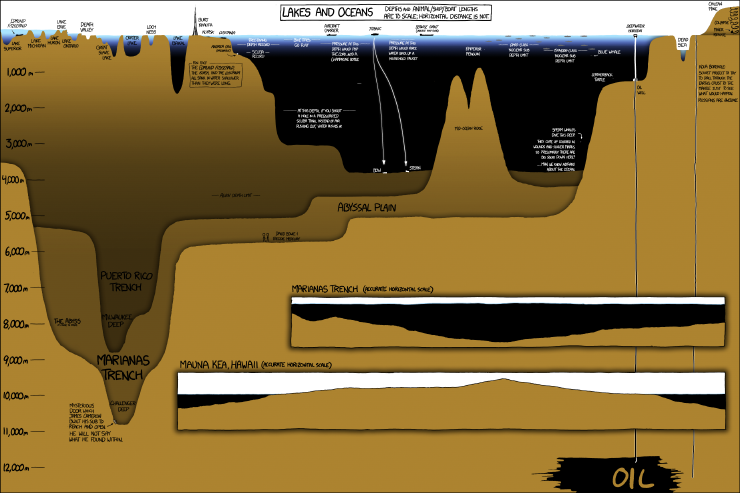
XKCD’s ocean depth graphic

Update: For more information about the graphic, see http://explainxkcd.com/1040/

The XKCD online comic strip frequently has some interesting graphics.

Below is one illustrating the relative depths (and some heights) of places on Earth. The depths and ship lengths show are all on the same scale; the horizontal scale is squeezed together, except for the two insert drawings.

A few things to look for:

  • The world’s tallest building, the Burj Khalifa in Dubai.
  • The maximum diving depths of blue whales, sperm whales, and sea turtles
  • The depth below sea level of the surface of the Dead Sea
  • The depth of the Deepwater Horizon oil well (the source of the horrific spill in the Gulf of Mexico) — both where it started and how deep it reached!

Click on the image for a much larger, more readable version:

XKCD \


Facebooktwitterredditpinterestlinkedintumblrmailby feather

Street-legal airplane

Here’s a small aircraft with foldable wings that can be driven on streets and highways, which interestingly means that it has a number of useful safety features (such as impact crumple zones and airbags) normally lacking in airplanes. In fact, it even has something you’re unlikely to find in most airplanes or automobiles: an emergency parachute for the whole thing.

Before you get too excited, prepare for a bit of sticker shock: The Terrafugia Transition, as its called, runs just under $280,000.


Facebooktwitterredditpinterestlinkedintumblrmailby feather

Google glasses — with ads

You might have seen the recent video promoting the concept of Google glasses (Goggles? Googgles?), but if not, Google had a project that hopes to invent eyeglasses that would superimpose relevant information seemingly in mid-air in front of you as you go about your day. The glasses would also include (or be connected to) a GPS receiver and cell phone, so you could get directions, see how close your friends are, and so on. It comes off as a mixture of cool and creepy.

(A similar concept is used in some aircraft and termed a “heads-up display” [HUD] because it enables the pilot to see instrument data without looking down at the instrument panel.)

Below is an abbreviated version of Google’s promotional clip, but this time showing you what it might really look like with the inevitable advertising included:


Facebooktwitterredditpinterestlinkedintumblrmailby feather

U.S. tax burden

How high taxes ought to be is a matter of opinion, but how high taxes are is a matter of fact.

Here in the U.S., many people think we’re taxed too highly, so it’s interesting to take a look at how our taxes compare with those of other industrialized nations. This isn’t as straightforward as it might seem, since countries have different governmental structures and tax systems, and obviously they also vary in terms of population and national income, The simplest comparison is probably to look at total taxes collected in all forms by all levels of government as a percentage of a country’s gross domestic product (GDP).

The organization Citizens for Tax Justice (to which, for the record, I’ve contributed a modest amount of money) recently published a report (PDF) comparing the tax percentage in the U.S. against that in 27 other countries, based on data from the Organization for Economic Cooperation and Development. (The numbers come from calendar year 2009, the most recent for which they were available.) A few interesting observations:

  • Total U.S. taxes come to 22.6 percent of GDP, lower than all but two countries on the list, Chile (18.2%) and Mexico (17.5).
  • The highest-taxed country on the list is Denmark, which pays a bit over 48% of GDP in taxes.
  • Of close U.S. allies, the United Kingdom pays about 34% and Canada about 31%.
  • As a percentage of GDP, U.S. corporations pay the second-lowest taxes on the list. Only in Iceland do corporations pay less.

(Edited slightly for clarity since the original post.)
(Also finally updated to include link to CTJ report.)


Facebooktwitterredditpinterestlinkedintumblrmailby feather