Speaker Ryan’s false claim about counties with no health insurers

In a town hall hosted by CNN on Monday (transcript here), Republican Speaker of the House Paul Ryan insisted, “Obamacare is collapsing. It is really — it is collapsing under its own weight” and “Obamacare is not working,” adding that “We’ve got dozens of counties around America that have zero insurers left.”

Update 2017 August 26: I missed the fact Speaker Ryan’s office had acknowledged that what Ryan said was incorrect, as pointed out by Politifact in an article rating Ryan’s claim false at the “pants on fire” level.

In fact, when Ryan spoke there was one county in Ohio — one county, not “dozens” — with no insurer signed up to offer individual policies on the exchanges next year. But that county now has an insurer, so the number of so-called “blank” counties is now zero. This despite the fact that the Trump administration has been doing a variety of things to destabilize the healthcare market in order to make his dire predictions come true. (For more on that, see this previous post. See also the Kaiser Family Foundation’s report on insurance availability.)

Ryan also claimed that nearly half of counties would have only one insurer. That might or might not be true, but a more important number is how many people will have a choice of health insurance companies, and that turns out to be more than 3/4. (See Kevin Drum’s concise post about that.)

It’s true that health insurance premiums have increased across the board (not just for individual policies on the Obamacare exchanges) mainly because the costs of healthcare have increased. But because of the way subsidies work, the vast majority of people buying individual policies are sheltered from those increases. The deductibles are another matter. For low-income working families who have silver plans, the Affordable Care Act offers help with paying the deductibles. People who are better off still have to pay them, which isn’t good. But prior to the ACA, they might not have been able to get health insurance at all, or the insurance they got might well have been cheap but largely worthless.

For that matter, Republicans have historically favored high-deductible plans to give patients “more skin in the game,” so they will supposedly shop around for cheaper doctors and hospitals and medical tests, as if that were a practical option for most people. And of course the “repeal and replace” bill Speaker Ryan favored would have left more than 20 million more Americans uninsured.

Update 2017 September 15: Last week a company suddenly pulled out of next year’s individual health insurance market in Virginia, leaving 48 counties without coverage. Today, however, Anthem agreed to fill the gap, which again everyone in the U.S. will be able to find a policy in 2018. If the administration would stop trying to sabotage Obamacare (see this post) the situation might not have arisen in the first place.


Facebooktwitterredditpinterestlinkedintumblrmailby feather

The most bizarre Confederate statue

Near Nashville Tennessee just off I-65 one can see what may be the single most bizarre and unintentionally hilarious statue in the world, supposedly depicting Confederate General Nathan Bedford Forrest. Reportedly made of injection-molded fiberglass possibly covered with foil (though it looks more like colored plastic to me), it has a “silver” figure of “Forrest” riding a rearing “golden” horse while firing a revolver wildly at something unseen off his port quarter, a direction Forrest isn’t looking.

It gets worse. The 25-foot-tall statue, which is on private land, was erected in 1998 by amateur sculptor Jack Kershaw, an attorney who defended the murderer of the Reverend Dr Martin Luther King Jr.

The mayor of the nearest town has asked the governor to conceal the eyesore. (See her open letter in the Nashville Tennessean.) Bill Dorris, the currently owner of the land under the statue, has vowed that if the view from the highway is blocked by trees or a wall or whatever, he’ll just put it on a taller pedestal. I can imagine this escalating to the point that the horse’s nose would have to be fitted with a flashing beacon for the safety of aircraft, which would make it even funnier. (By the way, according to The Washington Post, Dorris has called slavery a form of “social security” for African Americans. See also this report from WSMV television.)

There’s more, including hilarious photos, at RoadsideAmerica.com, Slate, Rachel Maddow, and The BlueShoe Nashville Travel Guide.

But the funniest take on it is below, from Friday’s Late Night with Stephen Colbert:


Link: https://youtu.be/LvCjM1lPwg4

In real life, General N Bedford Forrest was an untrained military genius who began the war as a private after a career that included slave trading but rapidly advanced up the ranks. Personally courageous, he showed no mercy to his opponents and was alleged to have committed at least one major war crime (but was never prosecuted for it). After the war he was a member of the Ku Klux Klan, and possibly one of its founders and leaders, though there seems to be some dispute about this. The statue doesn’t capture his physical likeness, but it might be a reasonably good depiction of his mentality.


Facebooktwitterredditpinterestlinkedintumblrmailby feather

Goop

I’m a huge fan of Gwyneth Paltrow and have been since Shakespeare in Love. She’s one of the best things about the Iron Man movies, for just one other obvious example. She’s a good actor with remarkable screen presence, and she’s immensely charming and likable.

Of course, her notions of medicine and health are total Crazy Town batshit whack-a-doo nuts, the sort of thing that could embarrass even the soulless greedy weasels who advertise crank pills and do-it-yourself colonoscopies on overnight television and via spam emails. But even there Paltrow manages to retain some appeal, since the stuff she hawks under her goop brand has the advantage of being hysterically funny.

So naturally, Stephen Colbert had fun with it. (Under 13 minutes total running time.)


Link: https://youtu.be/jd_T_IYVVV4


Link: https://youtu.be/Qg0HCStAYMA


Facebooktwitterredditpinterestlinkedintumblrmailby feather

Peter Kay on misheard song lyrics

Popular English comedian Peter Kay plays some easily misinterpreted song lyrics during a live show. (Some are mildly naughty, not suited for prime-time broadcast in the U.S.)


Link: https://youtu.be/UMYorpYNMKc

A little over five years ago I posted a link to a YouTube cartoon based on mishearing the words to “O Fortuna” here and mentioned in passing that

The general term for a misheard lyric is a “mondegreen,” a word originally proposed by Sylvia Wright in a 1954 essay in Harper’s Magazine. It’s one of the few deliberate coinages to make it into dictionaries. Wright derived the name from something she mis-heard as a child, specifically part of a ballad called “The Bonny Earl O’Moray.” Instead of “They hae slain the Earl O’ Moray and laid him on the the green,” she thought the words were “They hae slain the Earl O’ Moray and Lady Mondegreen.”

One of my personal favorite mondegreens was pointed out by Dave Barry, who noted that the opening words of “Help Me Rhonda” sound a lot like, “Ever since she left there’ve been owls puking in my bed.”


Facebooktwitterredditpinterestlinkedintumblrmailby feather

John Oliver on vaccines

This piece is very good and very informative, even to those of us who’ve already read and heard a lot on the subject. It also manages to be entertaining and funny despite the serious subject matter.

If you’re busy at the moment you might want to put off watching it since it does run nearly half an hour, but none of that is padding.


Link: https://youtu.be/7VG_s2PCH_c


Facebooktwitterredditpinterestlinkedintumblrmailby feather

Erasing history

As I don’t need to tell you, there’s a major debate currently going on in the United States about public statues honoring Civil War figures from the Confederacy. Those who advocate removing the statues object to honoring people who tried to maintain the institution of slavery.

While a lot of Southerners wish it weren’t so, preserving slavery was the primary goal of the Confederacy. It’s true that the South had many other grievances with the North, notably high trade tariffs that hurt Southern exports and led to a crisis a decade earlier. But what triggered secession was not a new tariff or anything of that sort; it was the election of Abraham Lincoln. Several states made explicit in their articles of secession that slavery was the issue at hand, and the Cornerstone Speech by Confederate Vice President Alexander Stephens delivered in Savannah on 1861 March 21 made this pretty clear as well, calling slavery “the immediate cause of the late rupture and present revolution” and declaring that ideas of racial equality were false: “Our new government is founded upon exactly the opposite ideas; its foundations are laid, its cornerstone rests, upon the great truth that the negro is not equal to the white man; that slavery, subordination to the superior race, is his natural and normal condition.”

Today, almost all of those who oppose removing the statues — even most of those who are open about their racism — acknowledge the evil of slavery, but to justify maintaining the statues they argue that removing them would amount to an attempt to erase history. There is of course a difference between remembering something and celebrating it, and most of the time the statues in question aren’t destroyed or melted down but merely relocated, typically to a museum. But advocates of maintaining them where they are contend that putting the statues out of sight amounts to hiding the history, which is practically the same as erasing it.

I have a serious question to those who take that position: If the absence of such a statute amounts to erasing history, then what about the history that’s already been erased?

There are many statues and memorials in the South honoring notable Confederate military leaders and even more meant to stand for unnamed Confederate soldiers defending their homes.

Where is there a comparable number of statues to stand for the millions of slaves whose labor built the antebellum South, or the slave families torn apart when a husband or wife or parent or child was sold, never to be seen again? Where are the statues honoring the men and women who risked their lives to help slaves escape via the Underground Railroad? Where are the memorials to the men and women denied their human rights by Jim Crow laws or murdered by lynch mobs? Where are the statues honoring leaders of the Civil Rights era and courageous individuals, many whose names are forgotten, who marched for justice or who quietly stood in line to register to vote even though they knew they’d be turned away, or who as courageous children or adolescents faced hatred and threats just to attend school or college? Such statues and memorials do exist, but generally not in the numbers or prominence awarded to figures of the Confederacy.


Facebooktwitterredditpinterestlinkedintumblrmailby feather

Two bits from SNL’s Weekend Update (summer edition)

From Thursday night’s prime-time episode of SNL’s Weekend Update, two pretty funny bits inspired by the current debate over Confederate statues and related matters. They feature the return of three former SNL regulars, including Tina Fey, my personal all-time favorite:


Link: https://youtu.be/iVvpXZxXWZU


Link: https://youtu.be/Z50OazqL6Xo


Facebooktwitterredditpinterestlinkedintumblrmailby feather

Very useful eclipse calculator (and traffic horror warning)

If you’re anywhere near the path of Monday’s solar eclipse in the United States, you’ll want to check out Vox’s eclipse page (link) to get an idea what the eclipse will look like where you live. Just enter your zip code and it will tell you the local time for the eclipse maximum, the percentage of totality you’ll experience, and even an animation showing you roughly what you can expect to see.

Speaking of seeing, and this is important, various news reports indicate that a significant fraction of the eclipse glasses being sold are fake and entirely inadequate. Some counterfeit glasses are reportedly stamped with an ISO designation meant to indicate safety certification, so contrary to press reports that’s no guarantee the glasses are safe.

Vanderbilt University has had to recall 8000 pairs of eclipse glasses, and a school district in Kansas discovered that more than 3000 it had purchased from Amazon.com were bogus.

Popular Science and CNET have advice on checking whether the glasses are safe. Please pass on these links:

http://www.popsci.com/fake-solar-eclipse-glasses
https://www.cnet.com/how-to/how-to-tell-if-your-solar-eclipse-glasses-are-safe-or-fake/

A quick test: Indoors, turn on a lamp with a shade on it. If you can see it through the eclipse glasses, they aren’t safe. If you glance at the sun through a pair of eclipse glasses it should look no brighter than a full moon.

I’ve experienced a total solar eclipse before, and I found that the most interesting part isn’t the eclipse proper but what happens around it, notably the daytime darkness. So I won’t be looking directly at the sun, I’ll be checking out everything else. And later I’ll look at the eclipse on line, in clear telescopic views better than I could possibly see through ultra-dark eclipse glasses. (I won’t be in the path of totality anyway, but where I live more than 90 percent of the solar disk will be covered, which is enough to keep me from trying to drive to South Carolina.)

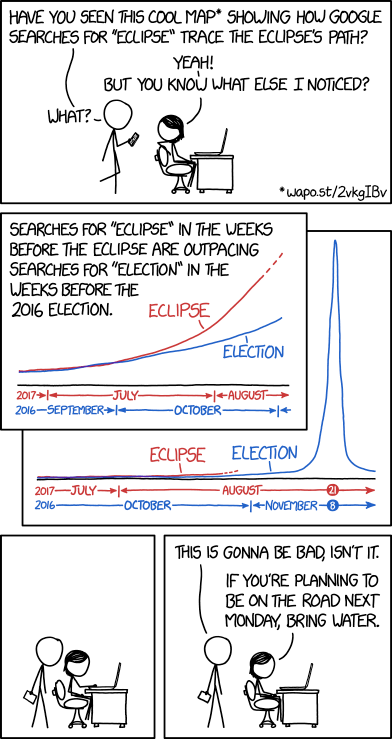
One more thing: Traffic into and out of the eclipse zone is likely to be horrendous. Here’s Monday’s XKCD comic about that:

Google traffic implies high automobile traffic to see eclipse

See https://explainxkcd.com/1876/ for more explanation of the comic.


Facebooktwitterredditpinterestlinkedintumblrmailby feather