A balanced view of firearms in the United States

This four-part video series is one of the best and most balanced overviews I’ve seen about firearms in the United States from the standpoint of healthcare. It was created by Indiana pediatrician and medical school professor Dr Aaron Carroll, whose Healthcare Triage series on YouTube I reference fairly often here.

I considered splitting the videos up over four successive days but in the end decided it’s more useful to combine them into a single post for reference, even then the combined running time is over half an hour. You don’t have to watch them all at once, of course.

A quick note about my own views: I’m a veteran, and during my years on active duty I often carried a sidearm. I’m not afraid of guns (but I am of some people with guns) and I don’t want to see them outlawed, which isn’t going to happen anyway. But if you really need a firearm for protection, especially a handgun, get trained and stay in practice. Otherwise you’re more likely to be a danger to yourself and others than a hero. Real life isn’t a movie.

Here’s a quick summary of some of Dr Carroll’s main points:

While mass shootings are horrific, in percentage terms they’re a relatively tiny problem, account for less than 2 percent of all gun deaths in the United States. Similarly, very few people are killed by so-called assault weapons. Steps to prevent mass shootings and sensible regulations on gun sales can make sense, but they don’t address the main real-world problem.

Homicide rates are far higher in the U.S. than in other relatively wealthy countries, and this is especially true of homicide by gun. Accidental gun deaths are also several times higher here. Of people who died of homicide by firearm across 23 high-income countries in 2010, 82 percent were in the United States. With respect to firearm homicides in 2010 of women and of persons under the age of 25, more than 90 percent occurred in the U.S.

A lot of people keep guns in the home to defend themselves from the danger of burglary or home invasion. Armed citizens do shoot intruders, and though I don’t think Dr Carroll mentions it, the risk of being shot by a resident probably scares potential intruders away. But in practice, guns in the home are far more often used in suicides — which greatly outnumber homicides — or in acts of domestic violence. There are also many, many accidental shootings, often involving children. Some researchers have reached the opposite conclusion, that more guns lead to less crime, but there are reasons to doubt these results, and for that matter some of the studies linking gun ownership rates to more homicides are also flawed. Unfortunately, for political reasons it’s become hard to get funding to research the subject.

The great majority of gun deaths are due to suicide. For example, in 2012 there were 33,363 deaths by gunshot in the United States. Of those, 12,093 were homicides, that is, the intentional killing of one person by another (whether justified or not), but 20,666 were suicides. People who commit suicide most often do so on an impulse, and those who try to kill themselves with a firearm succeed more than 85 percent of the time, versus only a few percent of those who try to use poison or a drug overdose. But restricting guns won’t eliminate suicide, and in fact suicide rates are higher in Japan and South Korea than in the United States despite the fact that stricter gun regulations mean that they use other means.

There is evidence that background checks for firearms purchasers lead to fewer gun deaths and that requiring permits to buy handguns is also beneficial. Guns don’t have to be outlawed — which, again, isn’t going to happen in the United States anyway — to reduce the murders, suicides, and accidental deaths by handguns.

(Incidentally, Dr Carroll errs in suggesting that fully-automatic firearms are banned in the United States. Outside the states with laws against them, it’s not too difficult to get a federal permit to purchase a machine gun. But there is a large practical impediment: The only ones legally for sale are limited in number, at least a few decades old, and very expensive.)

Part 1: A Brief History of Guns in America
(originally released on YouTube August 7)


Link: https://youtu.be/4ZzmgqpwG-s

Part 2: Homicide and Firearms
(originally released on YouTube August 14)


Link: https://youtu.be/mh5mMm7IECU

Part 3: Firearms and Suicide
(originally released on YouTube August 21)


Link: https://youtu.be/75alYlGCecc

Part 4: What Kind of Gun Laws Work?
(originally released on YouTube August 28)


Link: https://youtu.be/pXnycRj1KWs

Finally, here’s a bonus video from April 2015 on the same general topic, specifically addressing misguided political efforts in a few states to stop doctors from asking about one particular injury risk in the home, namely firearms. When I fill out a questionnaire in my doctor’s office I don’t get paranoid because I’m asked about various risks or whether I’m sexually active. (A few years ago I wrote, “No, I just lie there,” and for all I know that’s now in my medical record.) I don’t get paranoid and assume they want to come and -ahem- take my gun away, because that’s ridiculous. Congress has even passed laws preventing funding research on firearms safety, which is also silly. For more on the subject, see this list of links.


Link: https://youtu.be/nXJmdMoNuY4


Facebooktwitterredditpinterestlinkedintumblrmailby feather

What is cholera

You may recently have heard about the suffering caused by cholera, an infectious disease that can kill anyone but as with most infectious diseases is deadliest to the the youngest and the oldest. There’s an epidemic of it in Yemen, and the real cause of it is war.

I’m obviously guilty of posting a lot of videos from the brothers John and Hank Green, but they both have a gift for explaining complex subjects quickly and in a way that is both informative and humane. Here’s John Green, the older brother and novelist, laying out the key facts about the current cholera crisis in just under four minutes:


Link: https://youtu.be/OdYDkcjTK2k


Facebooktwitterredditpinterestlinkedintumblrmailby feather

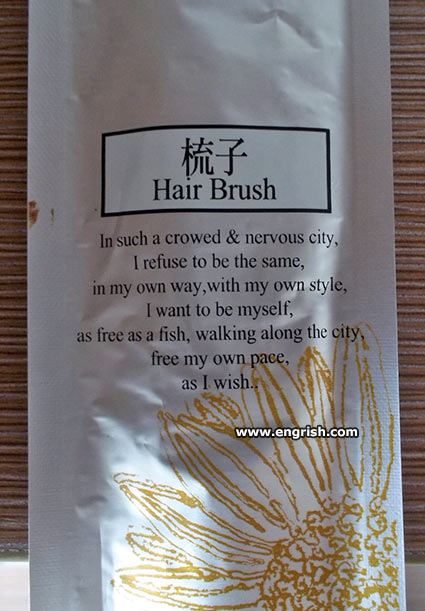
Free as a fish walking along the city

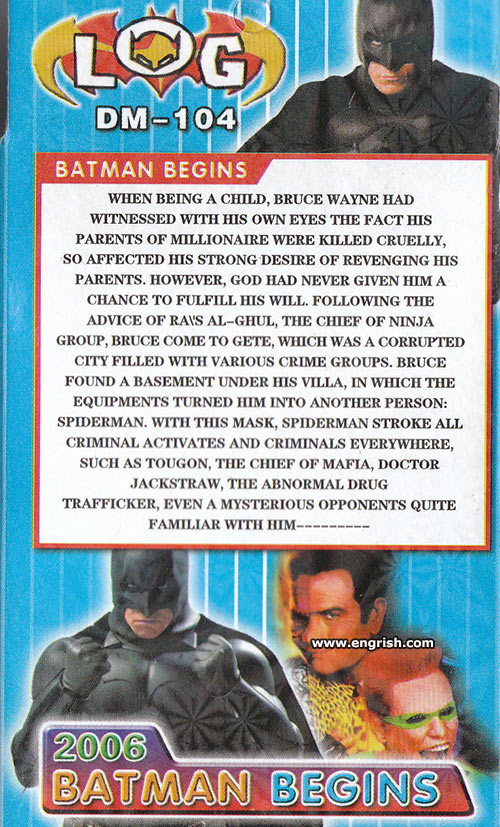
Here are a few more items from the folks at Engrish.com.

A hairbrush package from Taiwan:

Helpful signage from a Shanghai airport:

Also from Shanghai:

On a pirated DVD from China:

A notebook cover from South Korea:

Of course, if I were somehow tasked with translating something into Japanese or Chinese, or even French, a language I actually studied, my output would probably be even funnier.


Facebooktwitterredditpinterestlinkedintumblrmailby feather

On respecting experts

College courses in logic traditionally spend some time talking about fallacies, often identifying them by nifty-sounding Latin names. For example, an argumentum ad hominem (literally an argument “to the person”), is attack on another person’s character rather than a response to what they’re saying, and an argumentum ad ignoratium (“to ignorance”) amounts to declaring that if the other side can’t prove you wrong, you must be right. There are many lists of fallacies on the Internet, such as this one.

Even better, read Max Shulman’s hilarious short story “Love Is a Fallacy,” one of his series about college student Dobie Gills. In this story Dobie decides that his life goals require having a smart and beautiful wife, and since he’s not sure he can find that combination ready-made, he determines to start with a beautiful girl and teach her to be intelligent by educating her in logic. It’s often reprinted in logic textbooks, and if you haven’t yet read it, you really owe it to yourself to find it on line. There’s a PDF here, for example. Seriously, it’s worth the few minutes it will take you to read it.

(The classic television series The Many Loves of Dobie Gillis (1959-1963) had an episode with the same name, but the plot is quite different.)

One of the lesser-known fallacies is argumentum ad verecundiam, meaning an appeal to authority (literally to “reverence”). The idea is that an authority having said something doesn’t constitute absolute proof, because authorities can be wrong. This has obvious appeal to those who don’t want to believe what experts tell them and prefer to believe what they want to believe, but that’s if anything even less logical.

Recently Hank Green posted something very intelligent and succinct about paying attention to experts on the vlogbrothers channel, and I think it’s worth the three or four minutes it takes to watch:


Link: https://youtu.be/7FNsIFx1_4Y


Facebooktwitterredditpinterestlinkedintumblrmailby feather

Inception 2: Mario enters the Matrix

Glove & Boots is a YouTube channel featuring couple of puppets. Awhile back they spun off a gaming channel (called Glove & Boots Gaming, cleverly enough) where you can watch them play various video games and comment on them, often hilariously. (But that’s my judgment, and again I’m easily amused.) The main puppets are Fafa (who’s a groundhog) and Mario (who’s red).

In this 3-minute segment from a live stream on their gaming channel, Fafa is running the electronics off-camera so only Mario is on the screen. Fafa manages to put Mario in front of the delayed image on YouTube, with results that might remind you of the movie Inception.


Link: https://youtu.be/rwAJiMuNYAg

More Glove-&-Boots-related posts from this blog can be found here, or you can click the links above to go to the YouTube channels in question.


Facebooktwitterredditpinterestlinkedintumblrmailby feather

Sinclair broadcasting

When I worked in television in the early 1980s there were rules limiting how many television stations could be owned by a single company, both nationwide and in a single market. I thought this was a good idea at the time and I still do. Unfortunately the rules have changed, and while you might think you’re getting a diversity of channels over the air and especially on your cable system, in reality those channels have far fewer owners than you might expect. (The same is true of radio.)

Currently the largest single owner of local television stations in the United States is the Sinclair Broadcast Group, which is in the process of trying to buy, for $3.9 billion, Tribune Media, greatly expanding the number of television stations it owns, making it even more dominant, and reducing competition. Opposition comes not just from groups like Common Cause but from many parts of the business community. The Federal Communications Commission would have to approve the merger, but the current FCC, which has already reversed its longstanding support of net neutrality, may well be inclined to approve it.

One reason is that Sinclair’s management is extremely political, far to the right of Fox News, and routinely requires the stations it owns to broadcast hyper-partisan segments on local news broadcasts.

You can see examples in the clip below from Last Week Tonight with John Oliver originally broadcast in early June:


Link: https://youtu.be/GvtNyOzGogc

See also the August 7 article Variety by Cynthis Littleton.


Facebooktwitterredditpinterestlinkedintumblrmailby feather

Why not punish officials who deny citizens their right to vote?

An op-ed by Catherine Rampell in the August 24 Washington Post calls for punishing public officials who act to keep people from voting.

My only hesitation is a concern that some officials probably do honestly think that they’re doing the right thing in passing voter ID laws and the like. But when (as in North Carolina) legislators actively research which forms of ID are more likely to be used by people based on race, income level and likely political leanings, it’s pretty obvious that the purpose it voter suppression rather than voter integrity. The same holds for ending early voting on the Sunday before election day in response to learning that African American voter turnout is high on that day.

As Rampell points out, voter impersonation — the only type of voter fraud that could be affected by requiring voter ID — is extremely rare, especially in comparison with the number of legitimate voters disenfranchised by ID requirements and other things. The on-line version of her article has links to sources providing evidence for that. (See also my previous posts on an audit of the 2016 general election in North Carolina and on one voter ID horror story among many.)

Other states with a history of voter suppression efforts include Kansas (whose secretary of state, Kris Kobach, has a history of interference in elections and now heads President Trump’s “election integrity” commission) and Texas (whose efforts to suppress minority voting lately keep getting blocked by the courts). In some cases it’s not deliberate intent but negligent incompetence that denies citizens their voting rights, as when Kansas used defective software that effectively prevented people from registering to vote even though it told them their registrations had been recorded.

Rampell writes, “If we want state officials to stop erring so often on the side of disenfranchising voters, we need to change their incentives. That is, we need to start punishing them for illegally denying Americans the right to vote, rather than just have courts say, ‘Hey now, don’t do that again.'”

One way to change the system would be for courts to more often grant preliminary injunctions against new election laws undergoing a legal challenge.

“Once the damage is done you can’t really adequately repair it,” says Wendy Weiser, director of the Brennan Center’s democracy program. Courts could recognize this and err on the side of keeping the status quo, at least temporarily.

This would address only deliberate policy changes, though, not incompetence (as in Kansas’s software glitch). So why not raise the possible costs to getting things wrong, to change the calculus?

Congress or state legislatures could, for example, pass laws making it easier for state officials to be held liable for monetary damages if they have illegally denied someone their right to vote. Right now these officials likely have qualified immunity from such suits, according to Erwin Chemerinsky, dean of the University of California at Berkeley School of Law.

For American citizens, voting is a sacred and constitutionally enshrined right. It’s time the country, and those paid to serve the public, actually treat it as such.


Facebooktwitterredditpinterestlinkedintumblrmailby feather

Research paper concludes ExxonMobil misrepresented its own research on climate change

An article by Geoffrey Supran and Naomi Oreskes just published in Environmental Research Letters concludes that “ExxonMobil contributed to advancing climate science — by way of its scientists’ academic publications — but promoted doubt about it in advertorials. Given this discrepancy, we conclude that ExxonMobil misled the public.”

This is not a new accusation, though the paper by Supran and Oreskes goes into extensive detail in examining what the company’s scientists had concluded and what it had claimed in numerous communications with the public. Two years ago, Inside Climate News published an article by Neela Banerjee, Lisa Song, and David Hasemyer pointing out that according to a senior Exxon scientist named James F Black, in 1977 he had given a presentation in Exxon headquarters telling executives that there was general scientific agreement that CO2 from fossil fuels was leading to potentially serious global warming.

In 1982 Exxon distributed to executives a package of documents (which you can read here) that among other things explained that while there was at the time some remaining uncertainty, the scientific consensus was that human-caused global warming would likely raise global temperatures by about 1.3 to 3.1 degrees Celsius before the end of the 21st century, but that the warming would not be uniform across the Earth, with the polar regions warming by as much as 10 degrees Celsius (18 degrees Fahrenheit). Without a major reduction is fossil fuel use there was a possibility of irreversible “potentially catastrophic events.”

While the cover letter indicated the documents were not to be distributed outside Exxon, it also said that the information could be “used as a basis for discussing the issue with outsiders as may be appropriate.” In practice, however, a lot of Exxon’s advertising and public relations going forward minimized the problem, and by the 1990s Exxon was striving to block government efforts to limit carbon emissions and to create the impression that the science was uncertain and there was no urgent need to act.

Here’s a short, three-minute piece from the PBS series Frontline summarizing Exxon’s efforts to understand and then conceal information about global warming:


Link: https://youtu.be/ppfpFZ92JAY

See also the related article titled “Investigation Finds Exxon Ignored Its Own Early Climate Change Warnings” at this link.


Facebooktwitterredditpinterestlinkedintumblrmailby feather

What do historians think about removing Confederate statues?

Those who favor retaining monuments to the Confederacy often say that removing them has the effect of erasing history, and that they honor regional heritage and important figures with virtues as well as faults. Of course, a huge amount of that history and heritage is slavery and racism, and especially in the South statues and monuments dedicated to the Confederacy greatly outnumber those honoring the foes of slavery and the champions of Civil Rights. (See this post from a week ago.)

That said, it’s important to remember that by no means all defenders of these memorials are racists. In fact, even the most blatant racists and most enthusiastic defenders of Southern heritage, acknowledge the evil of slavery. Even those who try to paint slavery as relatively benign condemn it as an inherent evil. Indeed, attitudes toward slavery changed so rapidly after the Civil War that by the late 1800s Southern apologists were insisting that slavery wasn’t the cause of the Civil War and that it would have gone away in short order in any case (as Lincoln had hoped it might in the Lincoln-Douglas debates).

It’s also reasonable to consider soberly what should be done with historical monuments and statuary — which should be removed immediately, which be retained, and which perhaps modified in some way. The Associated Press recently published an article based on interviews with historians that’s worth reading. I won’t attempt to summarize it here because it’s not that long to start with.

I suspect most of us would agree that there’s no single simple answer that applies to all cases. At one extreme is the New Orleans monument to the Battle of Liberty Place, originally erected in 1891 to commemorate the violent overthrow of the elected state government by a paramilitary gang calling itself the “Democratic White League.” This was soon reversed by federal troops sent in by President Grant. It’s hard to object to getting rid of a monument meant to honor an explicitly racist attempted act of treason (though in fact quite a few did object). Andrew Vanacore wrote good summary of the monument’s history that can be read here. An inscription added in 1932 said that the battle had been a victory for white supremacy, but in 1974 a plaque was added saying that the monument no longer reflected modern attitudes, and in 1993 it was removed from its prominent place on Canal Street to a more obscure location next to a parking garage. In April of this year it was taken out of public view entirely. Given the monument’s clearly stated purpose, it seems hard to object to that, though of course many did.

On the other hand, almost no one calls for demolishing the Jefferson Memorial. Jefferson was a slave-owner who never freed the majority of his slaves, not even in his will (as had George Washington), but he also wrote against slavery, including in his original draft of the Declaration of Independence, and he proposed what became the Northwest Ordinance that among other things forbade the expansion of slavery into what later became the states of Ohio, Indiana, Illinois, Michigan, Wisconsin, and Minnesota.


Facebooktwitterredditpinterestlinkedintumblrmailby feather