What would Jesus do?

A high school girl in Rhode Island, the daughter of a firefighter and a nurse, is facing death threats and widespread hatred for supporting the U.S. Constitution.

In the 1960s her public school had placed an eight-foot-tall prayer on a wall in the school auditorium. Apparently some school officials at the time had decided that it was the government-operated school’s job — not that of churches or parents or students themselves — to tell children how to pray, and no one there had had the sense in the meantime to correct that mistake. A number of people, including students, objected to this government intrusion into private faith and tried to get the school to remove it, petitioning the school board as well as talking with school officials. Eventually the matter made it before a federal court, which of course ruled, correctly, that the local government was out of line.

Unfortunately, some residents of the town have gone bananas over this, apparently missing the point and supposing that a reasonable restriction on government was somehow an attack on religious faith.

One reason is that the one of the objecting students, the one who agreed to a request to serve as plaintiff in the case, calls herself an atheist, having lost her Catholic faith in childhood when prayers for her ailing mother seemed not to help. She was selected as plaintiff because under the law, a citizen can’t just sue to force the government to follow the law or the Constitution; the plaintiff has to show that his or her own rights were harmed in order to achieve what’s called “standing” — the right to sue to redress damage to oneself.

It’s remarkable to think that the people threatening this young woman apparently consider them followers of Jesus, who was also on record favoring separation of church and state (Matthew 22:21, Mark 12:17, Luke 20:25) and opposing showy public prayer (Matthew 6:5-8).

More recently, Rhode Island was itself founded by advocates of religious freedom, and entanglement of church and state was also opposed by Thomas Jefferson, James Madison, and other Founding Fathers. The First Amendment to the U.S. Constitution (drafted by Madison) clearly prohibits “an establishment of religion” — that is, a government-approved choice of religion — as well as forbidding the government to interfere with private exercise of religions faith. As a result children are completely free to pray in school on their own or in private groups, but the school can’t lawfully tell them when, how, or what to pray.

Incidentally, only 10 years after the ratification of the Constitution, President Adams signed and the Senate unanimously ratified a short treaty that was then published in many American newspapers, often on the front page. Article 11 of that treaty notes in part that “the Government of the United States of America is not, in any sense, founded on the Christian religion,” something that raised no objections because it was widely understood at the time that the government was supposed to be neutral on matters of religion, that being a matter of individual conscience.

It’s a shame some people in Rhode Island don’t know their history.

[revised slightly from original post for clarity]


Facebooktwitterredditpinterestlinkedintumblrmailby feather

Sheep-herding bunny

A rabbit named Champis, who lives in Sweden, likes to herd sheep:

I’m not sure about that choice of music…

According to the Associated Press Champis is self-taught. The video was shot by Dan Westman, a sheepdog breeder who’s friends with the bunny’s employers, Nils-Erik and Greta Vigren, and he’s very impressed with the bunny’s talents:

“I mean, I work with sheepdogs and know how hard this is. There are very few dogs that could do what this rabbit does.”


Facebooktwitterredditpinterestlinkedintumblrmailby feather

The U.S. economy today

Here’s a bit of interesting news: Today’s excellent jobs report from the Bureau of Labor Statistics sent the NASDAQ stock index to its highest level in 11 years.

As we’re all painfully aware, the United States is in the process of climbing out of a deep economic hole created by the worst recession in nearly 80 years. But as Catherine Rampell pointed out this morning (in a piece written before the unexpectedly good jobs numbers came out), the economy has actually been growing for 10 straight quarters since the federal stimulus came into effect, and while the growth rate has been lower than we’d have liked, at this point our gross domestic product (GDP) is actually larger than it was before the recession began in 2008.

Unfortunately, unemployment has remained a stubborn problem. As the graphs in this excellent piece by Steve Benen indicate, the private sector job situation started improving very soon after stimulus measures started taking effect two and a half years ago. At first jobs were still being lost, just at a rapidly declining rate, but for most of the last two years the private sector has been adding job again. Government jobs, especially at the state and local level, are still in decline, but not so much as they had been.

Among the dangers still facing us is a strong possibility of repeating a serious mistake from the mid-1930s. As you can verify for yourself by looking at historical GDP data (make sure you look at the “real” series adjusted for inflation and deflation), the economy fell off a cliff from 1929 through 1932 but then started growing again not long after President Franklin Roosevelt took office and the first New Deal programs came into effect. In fact, growth was so rapid that by the beginning of his second term the GDP was essentially back to where it had been in 1929. At that point FDR, worried about the size of the deficit, prematurely persuaded Congress to try to balance the budget. The result was a brief return to recession from mid-1937 to mid-1938. Fortunately that mistake was soon corrected and growth resumed, then soared during World War II when massive deficits fueled growth rates as high as 20 percent.

To be clear, I’m not suggesting that running huge deficits year after year is a good thing. But as long as the government is able to borrow on the financial markets at some of the lowest rates in history (which is currently the case) it’s not a crisis, and it’s still too soon to balance the budget without triggering another recession. Worst of all would be copying the massive spending cuts attempted for example by Ireland with terrible economic results. (See Martin Bashir’s recent report on that.)


Facebooktwitterredditpinterestlinkedintumblrmailby feather

Health Care Reform saves Medicare money

According to Josh Marshall’s Talking Points Memo political news and opinion site, the government reports that since the new rules on Medicare Advantage programs took effect, premiums have dropped by 7 percent, the number of participants is up by 10 percent, and taxpayers are saving money, a pretty remarkable combination of events.

Medicare Advantage is a branch of Medicare that allows people to choose a private insurance policy paid for partly by Medicare funds. As previously run, Medicare Advantage wound up costing taxpayers more money than conventional Medicare would have cost for the individuals covered. But under provisions of the Patient Protection and Affordable Care Act (also known as health care reform or “Obamacare”) that came into effect over a year ago, the overpayments have stopped. Republicans in Congress objected to the cost savings when they were proposed, contending that it would cause insurers to raise premiums and would drastically reduce the number of people choosing Medicare Advantage.

In fact, exactly the opposite happened. At the risk of repeating myself, premiums went down, enrollment went up, and taxpayers are saving money. Not a bad result!


Facebooktwitterredditpinterestlinkedintumblrmailby feather

Rescued U.S. auto industry now booming

Steve Benen (who has moved his blog from The Washington Monthly‘s website to Rachel Maddow‘s at MSNBC) makes some good points in his post yesterday on the thriving state of the U.S. auto industry, one of the brightest spots in the current U.S. economy. (See also Andrew Leondard’s piece at Salon.)

Back in the spring of 2009 both GM and Chrysler were on the verge of going out of business, throwing a staggering number of people out of work and putting many related companies out of business. The Obama administration responded by temporarily taking over GM and Chrysler and giving them enough funds to restore their profitability so that taxpayers could be paid back as soon as possible. The result has been a spectacular success. Chrysler, which had been in trouble since long before the recession began, has just posted its first profit since the booming Clinton years.

As Benen reminds us, the Republican leaders at the time predicted certain disaster. House Minority Leader (now Speaker) John Boehner of Ohio asked, “Does anyone really believe that politicians and bureaucrats in Washington can successfully steer a multi-national corporation to economic viability?” Republican South Carolina Senator Jim DeMint complained, “Now the government has forced taxpayers to buy these failing companies without any plausible plan for profitability.” Alabama Senator Richard Shelby said, “It’s the road toward socialism.” Republican National Committee Chairman Michael Steele called it, “nothing more than another government grab of a private company and another handout to the union cronies who helped bankroll his presidential campaign.”

And current Republican frontrunner Mitt Romney wrote on the National Review website that it would be necessary for “the Obama administration to keep up the subsidy for years and years to come.” He called the rescue plan “as ineffective as it is un-American” and “even worse than bankruptcy — it would make GM the living dead.”


Facebooktwitterredditpinterestlinkedintumblrmailby feather

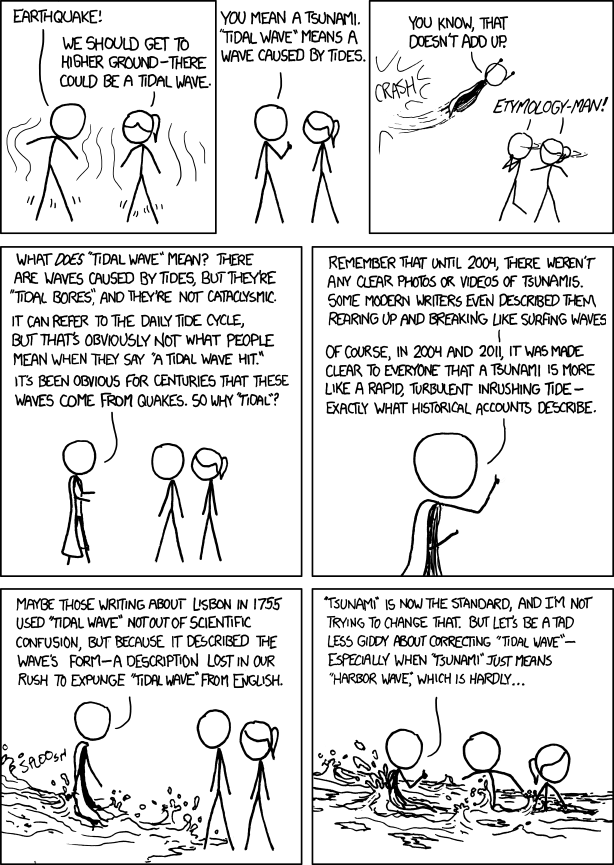
Tidal wave

The deserved popular XKCD web comic strip makes a good point here that had occurred independently to me after seeing videos of the terrible Japan tsumani last year: Efforts to discourage use of the term “tidal wave” misguided, because while it’s true that they’re not caused by tides, they behave a lot like a rapidly rising tide. But I never got around to saying that except possibly in a conversation or two, so XKCD deserves the credit:

XKCD comic from 2012 January 31


Facebooktwitterredditpinterestlinkedintumblrmailby feather

Martin Bashir on the failure of austerity in Europe

Martin Bashir, who now hosts a program on MSNBC, makes an excellent point on the failure of so-called austerity measures (greatly reduced government spending in the face of a falling economy) in the European countries where it’s been tried. As Bashir points out, Romney, Gingrich, and other Republicans keep accusing Obama of imitating Europe when in fact it’s the GOP that’s pushing the policies that have led to miserable results in Ireland, the UK, Spain, and elsewhere.

Meanwhile, I would add, the countries that maintain relatively good safety-net programs (what Republicans typically mean when they refer to European social programs, and which Obama has unfortunately not really advocated) are doing better than their neighbors.


Facebooktwitterredditpinterestlinkedintumblrmailby feather

Is Congress in recess or not?

A few days ago President Obama initiated the routine process of raising the national debt ceiling. Republicans in Congress loudly objected that this wasn’t fair because Congress is recess, so Obama agreed to postpone the matter until later.

Yesterday President Obama made some recess appointments, which the Constitution empowers presidents to do when Congress is in recess. Now, of course, Republicans are complaining that Congress, which they had just said was in recess, is not in recess after all, because about every three days a handful of people in the House hold a pro-forma session for literally a matter of seconds during which no business is allowed. Even the Republican leadership admits that the only purpose for these sham meetings is political, to try to stop the president from exercising his constitutional authority to make recess appointments.

As Steve Benen points out in a useful summary of the situation, Congress’s own non-partisan Congressional Research Service has expressed doubts about the validity of such political tricks intended solely as an end-run around the Constitution.

The same CRS report also notes in passing that through 2011, Obama had made just 28 recess appointments versus Reagan’s 240, George H. W. Bush’s 77, Clinton’s 140, and George W. Bush’s 171. Of course, Obama has been in office for not quite three years, so a fairer comparison would be the average number of recess appointments per year for recent presidents: Reagan 30, the younger Bush 21, the elder Bush 19, Clinton 18, and Obama 9.

As you know if you’ve paid any attention to recent events, Congressional Republicans have been trying (often successfully) to block almost any positive action on the economy in the hope Obama would take the political blame for the resulting stagnation. Presidents and Congresses have fought in the past, but what the Republicans are doing really is, no exaggeration, literally unprecedented. In the meantime, Democrats and Obama have bent themselves into pretzels compromising to try to make a little progress.

Even a number of conservative Republicans, including just a few days ago Mike Huckabee, have been expressing concern that too many in their own party care more about political advantage than helping the country.

For more on the story behind the first of yesterday’s recess appointments, follow these links to articles by Jonathan Cohn and James Fallows. In brief, the Republicans have been blocking a vote on a candidate even Minor Leader Senator McConnell acknowledged was a good choice because the minority wants to overturn an existing law that makes it a little harder for big banks to rip off their customers.


Facebooktwitterredditpinterestlinkedintumblrmailby feather